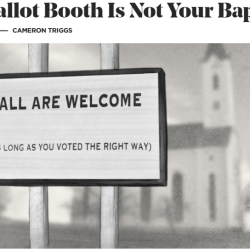
GUIDE: CCPL Guide to Voting

The "CCPL Guide to Voting" is a non-manipulative voting guide for Christians, encouraging thoughtful civic engagement prioritizing love for neighbor and communal flourishing. It presents five key questions to consider when voting: what you're passionate about, how candidates meet personal and community needs, the cultural impact of candidates, and whether you would regret your vote if it determined the election outcome. If you don't know where to begin when it comes to voting, this short guide is an excellent starting point.

Compassion (&) Conviction book cover

BOOK: Compassion (&) Conviction

Many Christian American voters are tossed about by their ideological political party as they lack a framework for engagement. Instead of the Bible dictating a Christian's politics, partisan politics dictate what Christians go to the Bible for. For Christians, this should not be so. In Compassion (&) Conviction, Justin Giboney, Michael Wear, and Chris Butler clearly and succinctly explain why Christians should be involved in politics, define a biblical framework for approaching politics, explain how Christians can engage in partnership with those that hold different values, and show how Christians can be distinctly Christian in the public square.

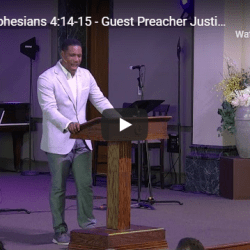
SERMON: Ephesians 4:14-15

In an engaging and thoughtful 45-minute sermon rooted in Ephesians 4:14-15 Justin Giboney challenges, "Christians on both sides of the political spectrum...to ask themselves if they are going to be accomplices or cross bearers? Will [they] add to the tribalism and division or will [they be] models of civility and reconciliation?" Giboney provides a framework for Christiians to engage politics in a distinctly Christian way that is not partisan, but anchored in truth, love, justice, and moral order. Note that the audio for the first half of the video is out of sync.

PODCAST: Where the Gospel Meets Politics #30

In a polished Radiolab (NPR) style presentation complete with commentary interspersed between interviews and upbeat music hosts Jesse Eubanks and Lachlan Coffey expertly tell the story of polarization, specifically negative polarization, and its two preeminent effects on Christians. First, it creates a sense of political homelessness which results in silence and Christians disengaging from the political sphere. Second, it destroys our ability to talk with our neighbors. If you are looking for a podcast that is different from the traditional interview or commentary style podcast - then this is your cup of tea.

SHOW: How should Christians vote?

Holy Post host Phil Vischer begins by digging into the conservative and liberal labels that have morphed into ideologically constrained camps that vote according to party instead of personal conscience before finishing the 7-minute video with helpful advice on how Christians should vote. Hint--it starts with rejecting tribalism.

BOOK: Rehumanize

The vast majority of humanity tolerate some form of violence towards their fellow human beings. We are pro-abortion, but anti-death penalty or pro-war, but anti-euthanasia. There is a distinct lack of consistency in our value of life. In Rehumanzie Aimee Murphy does a marvelous job of explaining the values and origins of the consistent life ethic (CLE) while showing the interconnectedness of issues associated with life. For example, the amount of money America spends on the military directly affects how much we contribute to fight poverty. Another example is the same drugs that are used in abortions are used in euthanasia.

MOVIE: Ernie & Joe: Crisis Cops

On average police officers in academies across the United States spend 60 hours learning how to shoot a gun while spending just eight hours on mental health and communication - Ernie Stevens and Joe Smarro want to change that. Ernie and Joe: Crisis Cops provides an intimate look at the partners and best friends as they respond to mental health calls for the San Antonio Police Department's Mental Health Unit, provide training to their fellow policemen, and navigate everyday life.

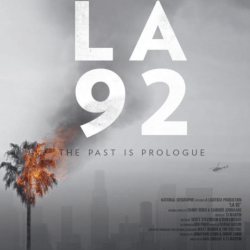
MOVIE: LA 92

At first glance LA 92 is a history lesson about the Los Angeles violence in 1992 following the Rodney King verdict, but just below the surface is a warning and a call for Americans to wake up. For hundreds of years Black people and people of color have complained about police brutality and, unfortunately, most of the time white people have ignored or dismissed the calls for help or justice. This indifference and callousness combined with other issues such as high unemployment, underfunded schools, and aggressive policing tactics has led to frustration which manifests itself in violence.