A short 21-minute sermon, delivered with mirth, from pastor Thomas McKenzie on five principles from Colossians 1:11-20 for Christians to engage in politics well.
Curated topics for a disillusioned church

A short 21-minute sermon, delivered with mirth, from pastor Thomas McKenzie on five principles from Colossians 1:11-20 for Christians to engage in politics well.

How does a Christian distinctly advocate in the political sphere? How should a Christian's faith mold their politics? For the Love follows activist Justin Giboney, local board member Sarah Imboden, and South Carolina Senator Tim Scott as they put their love of neighbor into action. Highly recommended.

Politics matter. Politics matter because policies affect people. Policies affect Christians and non-Christians alike as they shape the community we live in. But, where does a Christian start politically? How does a Christian engage, advocate, and debate in the public sphere? What does the Bible have to say about politics? With humor and grace and a nod towards the Ten Commandments Eugene Cho in Thou Shalt Not Be a Jerk lists 10 "thou shalts" a Christian should follow when engaging in the public sphere.
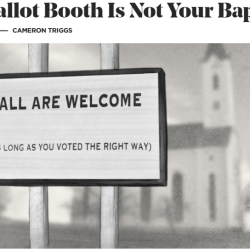
No political party, candidate, or law can have a Christian's allegiance. If one of those political entities does, it is political idolatry. Pastor Cameron Triggs of Grave Alive (Orlando, FL) provides several principles, including that candidates are fallible and neither party is Christian, as ways to keep our idolatry in check.

Many Christian American voters are tossed about by their ideological political party as they lack a framework for engagement. Instead of the Bible dictating a Christian's politics, partisan politics dictate what Christians go to the Bible for. For Christians, this should not be so. In Compassion (&) Conviction, Justin Giboney, Michael Wear, and Chris Butler clearly and succinctly explain why Christians should be involved in politics, define a biblical framework for approaching politics, explain how Christians can engage in partnership with those that hold different values, and show how Christians can be distinctly Christian in the public square.
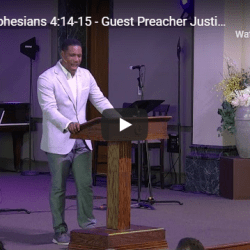
In an engaging and thoughtful 45-minute sermon rooted in Ephesians 4:14-15 Justin Giboney challenges, "Christians on both sides of the political spectrum...to ask themselves if they are going to be accomplices or cross bearers? Will [they] add to the tribalism and division or will [they be] models of civility and reconciliation?" Giboney provides a framework for Christiians to engage politics in a distinctly Christian way that is not partisan, but anchored in truth, love, justice, and moral order. Note that the audio for the first half of the video is out of sync.

Mental health counselor William Bowes says that pride, the moralization of politics, and the politicization of morals are three major reasons why people are contentious when discussing politics. How do we solve those issues as Christians? By turning off cable news and learning about different perspectives, by treating everyone with dignity and respect regardless of their political views, and by engaging in conversation with an abundance of humility.

In a polished Radiolab (NPR) style presentation complete with commentary interspersed between interviews and upbeat music hosts Jesse Eubanks and Lachlan Coffey expertly tell the story of polarization, specifically negative polarization, and its two preeminent effects on Christians. First, it creates a sense of political homelessness which results in silence and Christians disengaging from the political sphere. Second, it destroys our ability to talk with our neighbors. If you are looking for a podcast that is different from the traditional interview or commentary style podcast - then this is your cup of tea.

Preaching from Mark 12:13-17, Church of the City (New York, NY) pastor Jon Tyson lists five purposes for the state and government (order, justice, virtue, prosperity, safety) and then lists five things Christians uniquely bring to government (dignity, care for the poor, suspicion of human nature, priority of the other and the power and favor of God).

What links abortion and euthanasia? War and poverty? The death penalty and embryonic research? Racism and environmental damage? Violence. Specifically violence against human beings. Through a collection of excerpts from books, journals, articles, and speeches Consistently Opposing Killing focuses on the key tenets of the consistent life ethic (CLE), details some of the history of the movement, and provides a way to talk about the CLE with others.
 Sunday to Saturday
You must be logged in to post a comment.