A short 21-minute sermon, delivered with mirth, from pastor Thomas McKenzie on five principles from Colossians 1:11-20 for Christians to engage in politics well.
Curated topics for a disillusioned church

All of the curated sermons on Sunday to Saturday. Visit our Listen Notes page or YouTube page for curated topical playlists.
A short 21-minute sermon, delivered with mirth, from pastor Thomas McKenzie on five principles from Colossians 1:11-20 for Christians to engage in politics well.
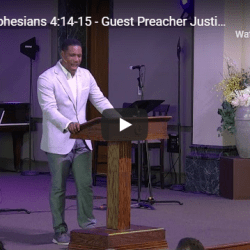
In an engaging and thoughtful 45-minute sermon rooted in Ephesians 4:14-15 Justin Giboney challenges, "Christians on both sides of the political spectrum...to ask themselves if they are going to be accomplices or cross bearers? Will [they] add to the tribalism and division or will [they be] models of civility and reconciliation?" Giboney provides a framework for Christiians to engage politics in a distinctly Christian way that is not partisan, but anchored in truth, love, justice, and moral order. Note that the audio for the first half of the video is out of sync.

Preaching from Mark 12:13-17, Church of the City (New York, NY) pastor Jon Tyson lists five purposes for the state and government (order, justice, virtue, prosperity, safety) and then lists five things Christians uniquely bring to government (dignity, care for the poor, suspicion of human nature, priority of the other and the power and favor of God).

Pastor and theologian Tim Keller says that Jesus was simultaneously political and not political because Jesus's definition of power is different from the world's definition. Keller explains that true power, as interpreted by the world, consists of coercion and power over people while power, as defined by Jesus, lies in self-sacrifice that results in changing people internally.
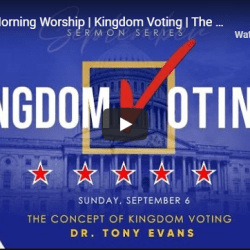
Using a football game with two teams (the warring ideologies of culture), officials (Christians), a rule book (the Bible), and a crowd (the people of the world) as analogies for how Christians should engage in politics Oak Cliff Bible Fellowship (Dallas, TX) pastor Tony Evans preaches from Joshua 5:13-15 as he details a distinct perspective God has on voting. Go 24 minutes in to start the sermon.
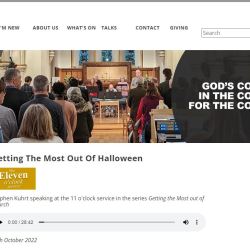
Pastor Stephen Kuhrt of Christ Church New Malden (New Malden, England) says that most people who celebrate Halloween do not celebrate evil, but, at the same time, do not take evil seriously enough. Kuhrt advocates that as Christians we should not unequivocally reject or accept Halloween, but take the opportunity to acknowledge that evil exists in the world, but it will not win.

Preaching out of Acts 17:16-31 pastor Luke Gilkerson looks at how Paul receives, rejects, and redeems the culture as a template for how Christians can approach Halloween.

What if before we walked into a room we told ourselves that we represent the image of God in this room? In a challenging and insightful sermon author and pastor Skye Jethani says we have been taught that we are created to serve God, which he says is a pagan calling, but what we have really been created for is for representing God, which is a Christian calling.
Pastor David Ellis of Astoria Community Church (Astoria, NY) asks what does it mean to be made in the image of God? Is it our intelligence? Is it how we look? Is it our creativity? Ellis postulates that it is none of those as there are some people that are less intelligent and less creative as others, but are still fully made in the image of God. Ellis, instead, says that our capacity to have a relationship with God is what sets us apart and that God created us for three things - dignity, equality, and responsibility.

Any kingdom of the world is incompatible with the kingdom of God. As a result, when Christians fuse the sword and the cross we just become another version of a kingdom of the world. In an ardent sermon that resulted in losing over 1000 members of his congregation in 2004, Woodland Hills (St. Paul, MN) pastor Greg Boyd says the defining marker of the kingdom of God is that it looks like Jesus. Therefore the distinct marker of a disciple of the kingdom of God is Calvary-like love (Eph. 5:1-2, Lk 14:27).
 Sunday to Saturday
You must be logged in to post a comment.