ARTICLE: Why can’t we talk about politics? A counselor’s take

Mental health counselor William Bowes says that pride, the moralization of politics, and the politicization of morals are three major reasons why people are contentious when discussing politics. How do we solve those issues as Christians? By turning off cable news and learning about different perspectives, by treating everyone with dignity and respect regardless of their political views, and by engaging in conversation with an abundance of humility.

ARTICLE: How Christians Should Think About Voting

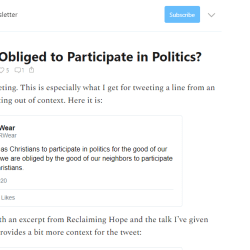
Founder and president of the Center for Christianity and Public Life Michael Wear says that American political parties put an improper moral burden on its people. Political parties are incentivized to cater to the public as a brand rather than appeal to the voters on specific issues. This strategy results in people believing something because they are part of a political party instead of educating themselves on specific issues. With that in mind, Wear suggests three concepts to consider while voting: Jesus is not confused about how our politics works, Christians don't go into politics for self-interest alone, and listen to others particularly those that disagree with us.

ARTICLE: Why Our Sunday School Disciples Christians in Politics

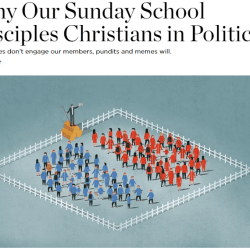
Pastors have no problem guiding believers on how to follow Jesus in marriage, in the workplace, or at school, but few breach the subject of politics. In that vacuum social media and cable news does the discipling--not a pastor and not the Bible. Pastor Sam Haist of Redeemer Presbyterian Church (Indianapolis, IL) encourages pastors to provide parishioners with a distinctly Christian Biblical framework for how to engage in politics. He suggests focusing on principles before policies, using the curriculum developed by the Center for Public Justice, and prioritizing love which means treating people with dignity and respect in addition to a large dose of humility.