SHOW: Holy Post Voter Guide Series

Beginning in March of 2024 the Holy Post started a weekly voter guide complete with a short, sub-3-minute video discussing a pertinent topic related to politics, useful resources about the topic, a weekly prayer, and a moment of joy. The guides have touched on consuming media, not having the last word, being curious, local politics, and anger. The hosts don't tell you who to vote for or what to think but offer a uniquely Christian posture on how to approach politics. Highly recommended.

LECTURE: On the Early Church & Politics

What is the foundation that Christians should build from when voting? What does the Bible have to say about government? What does the Bible have to say about authority? Pastor Tim Mackie says that since the start of American politics Christians and non-Christians have cherry-picked verses to support their agenda. This is a two-fold tragedy. First, it removes the verse from its context. Second, it uses the Bible when it is convenient instead of listening to the Bible and patiently working through the entire story. Mackie's passion for the Bible bleeds through his lecture as he dives into Genesis 1 as a political theology. He connects the image of God to ruling authority to justice and then to politics. His in-depth theological analysis of the foundation of Christian political engagement is a masterclass on what the Bible says about a Christian's political involvement.

SHOW: How should Christians vote?

Holy Post host Phil Vischer begins by digging into the conservative and liberal labels that have morphed into ideologically constrained camps that vote according to party instead of personal conscience before finishing the 7-minute video with helpful advice on how Christians should vote. Hint--it starts with rejecting tribalism.

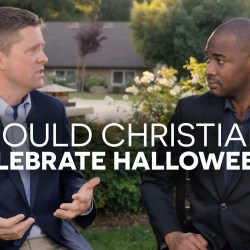
SHOW: Should Christians Celebrate Halloween? (Masters Seminary)

In a short four minutes Master's Seminary historical theology professor Nathan Busenitz suggests two principles for Christians to use when approaching Halloween. First, anything that is overtly sinful needs to be avoided. Second, Christians can use their Christian liberty (Romans 14 and 15; 1 Corinthians 8 and 9). To further flesh this approach out he suggests asking several questions: Is this activity something that dishonors Christ? (1 Cor. 10:31). Is this activity something that violates my conscience? (1 Cor. 8 and 9) Is this an activity that may cause a weaker brother to stumble? (1 Cor. 8)