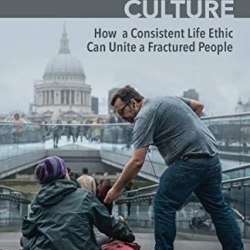
Compassion (&) Conviction book cover

BOOK: Compassion (&) Conviction

Many Christian American voters are tossed about by their ideological political party as they lack a framework for engagement. Instead of the Bible dictating a Christian's politics, partisan politics dictate what Christians go to the Bible for. For Christians, this should not be so. In Compassion (&) Conviction, Justin Giboney, Michael Wear, and Chris Butler clearly and succinctly explain why Christians should be involved in politics, define a biblical framework for approaching politics, explain how Christians can engage in partnership with those that hold different values, and show how Christians can be distinctly Christian in the public square.

BOOK: Consistently Opposing Killing

What links abortion and euthanasia? War and poverty? The death penalty and embryonic research? Racism and environmental damage? Violence. Specifically violence against human beings. Through a collection of excerpts from books, journals, articles, and speeches Consistently Opposing Killing focuses on the key tenets of the consistent life ethic (CLE), details some of the history of the movement, and provides a way to talk about the CLE with others.

BOOK: The Ballot and the Bible

Despite the decline in American church attendance quoting the Bible in the public square still holds cultural sway. Each year presidential hopefuls reference Matthew 5 and the city on a hill while those whose political party is in power appeal to Romans 13. One of the most recent egregious examples happened in June of 2020 when President Donald Trump posed in front of St. John's Church in Washington D.C. with a Bible in hand for an awkward photo-op. When asked if the Bible was his he replied, "It's a Bible." These examples show people using the Bible, and it's cherry-picked verses, as political props--and it's been happening since the beginning of the United States. In The Ballot and the Bible Kaitlyn Schiess asks us to peer through the lens of traditional and contemporary American history to examine how Americans have used the Bible for both good and bad in the public sphere while asking the reader to examine their own tendencies to manipulate the Bible for their own political beliefs.

BOOK: Consistently Pro-Life

If you asked a random person who identified as a Christian what a Christian ethic of life is or what the basic tenants of a consistent ethic of life are they would likely focus on abortion for the first question and not be able to answer the second question. Author Rob Arner, in Consistently Pro-Life: The Ethics of Bloodshed in Ancient Christianity, hypothesizes that, in general, modern Christians' approach towards the ethic of life has been "sloppy, ad hoc, and piecemeal at best" and that the ancient church has a blueprint for how to approach the ethic of life in modern times.

BOOK: Reclaiming Hope

In the introduction to Reclaiming Hope Michael Wear provides a fitting definition of reclaim which includes recovering a wasteland. Most Americans, no matter where they stand on the political spectrum, would agree that our current political climate is a wasteland. The means always justify the ends--especially if it humiliates and defeats the opponent. Compromise is blasphemy. Partisanship is king. Simply put elected officials and the voting public have lost hope.

BOOK: Rehumanize

The vast majority of humanity tolerate some form of violence towards their fellow human beings. We are pro-abortion, but anti-death penalty or pro-war, but anti-euthanasia. There is a distinct lack of consistency in our value of life. In Rehumanzie Aimee Murphy does a marvelous job of explaining the values and origins of the consistent life ethic (CLE) while showing the interconnectedness of issues associated with life. For example, the amount of money America spends on the military directly affects how much we contribute to fight poverty. Another example is the same drugs that are used in abortions are used in euthanasia.

BOOK: Lent – The Season of Repentance and Renewal

Important liturgical seasons, especially if you were not brought up in a liturgical church, such as Lent can be intimidating. Where do I start? How do I honor the season? What if I do it wrong? These questions, and many others, can prevent those with the best of intentions from engaging with the season. That is where Lent: The Season of Repentance and Renewal by Esau McCaulley comes into play. In a short, accessible 112 pages McCaulley demystifies, explains, and examines the traditions, the prayers, the rituals, and the Scriptures of the Lenten season.

BOOK: Resisting Throwaway Culture

What would the world look like if Christians, and non-Christians, lived a life focused on a culture of hospitality and encounter? What if we rejected the pervasive consumerist culture that sees humans, especially the poor and the vulnerable, as commodities to be used? Professor of Medical Humanities at the Creighton University School of Medicine Charles Camosy, building upon the Consistent Life Ethic (CLE) advocated for by Cardinal Joseph Bernardin, Pope St. John Paul II, Pope Benedict XVI, and Pope Francis, provides a compelling framework and well-reasoned arguments for approaching sex, abortion, climate, non-humans, and violence, among other polarizing subjects, in Resisting Throwaway Culture.

BOOK: Martin Luther King, Jr.: A Life

The duplicity of human nature is a conundrum. We are capable of extraordinary acts of greatness and kindness, while at the same time, we are capable of profound evil and harm. This is true of all humans and even those that lead to monumental positive societal change such as Martin Luther King Jr. Marshall Fraday's Martin Luther King Jr.: A Life paints Martin as a fellow human being trying to find his place in the world. Is he doing the right thing? Is he the right leader for the movement? Is it time to give up? Does he change tactics? King deals with depression, failure, lust, success, and elation. Pride and humility are constantly warring within him.

BOOK: Halloween – From Pagan Ritual to Party Night

Most Christians participate or do not participate in Halloween based on their own cultural context. Some reject the holiday outright saying it is a holiday devoted to Satan while others wholly participate. Both do so without knowing the history of the holiday. In Halloween: From Pagan Ritual to Party Night Nicholas Rogers touches on various aspects of Halloween such as its historical roots, cultural influences, folklore, and societal impact.