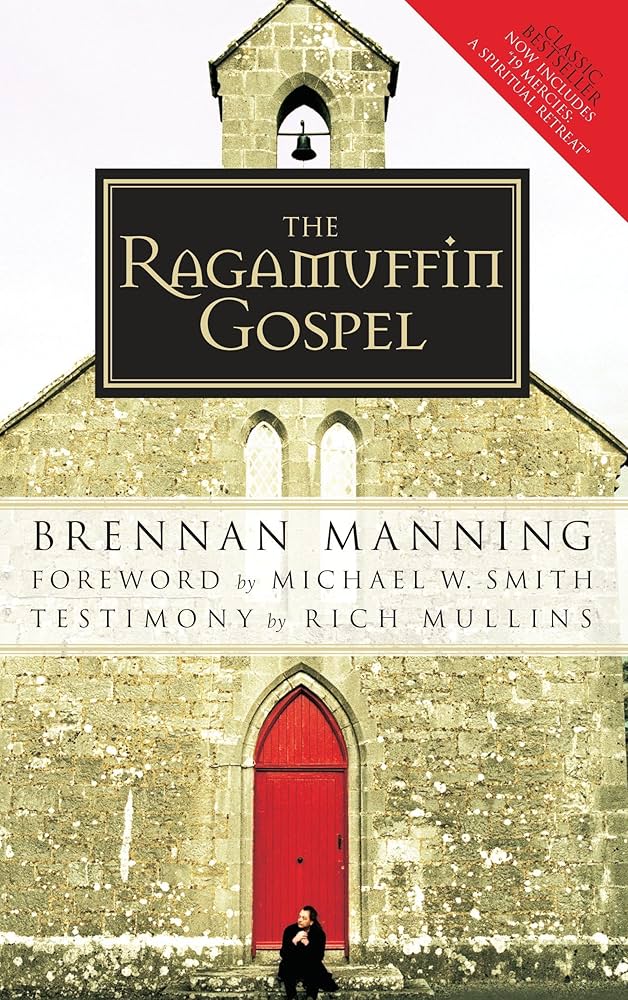
By Brennan Manning | Amazon.com | 272 pages
Published in June of 2005
SUMMARY: The Ragamuffin Gospel is not so much a theological treatise as it is a wake-up call—one delivered gently but insistently to the soul that keeps trying to earn what Christ has already given. Brennan Manning’s premise is simple: most Christians do not actually believe in the incomprehensible, unearnable grace of God. We nod politely at grace in our Sunday best, but spend the rest of the week anxiously polishing our halos.
Against this instinct, Manning announces a bracing truth. As he writes, “The gospel declares that no matter how dutiful or prayerful we are, we can’t save ourselves. What Jesus did was sufficient.” And in one of his sharpest observations, he reminds us that the Pharisee within—the self-made saint—risks watching “prostitutes and publicans go first into the kingdom,” while we stand in the background. Why do the “hookers and swindlers” enter ahead of us? Because, Manning says, they know they have nothing to bargain with. They throw themselves wholly on the mercy of Christ; they do not try to negotiate their worth.
This is the drumbeat of the entire book: God’s grace cannot be earned, polished, bartered for, or revoked. It is not a wage. It is a handout—one that the ragamuffins among us are humble enough to accept.
Critics of The Ragamuffin Gospel often focus on Manning’s theological tangents, anecdotes, and idiosyncratic perspectives. Some of these objections are valid, particularly for readers from traditions concerned with precision, systematics, or doctrinal completeness. However, these critiques often overlook the main point. Manning is not building a theological system, nor does he pretend to. This is not “Ragamuffin Christianity,” as if he were proposing an entirely new denomination. Rather, it is a reminder—a movement, if one must call it that—of like-minded believers gathering around the uncontroversial (though often unrealized) center of Christian faith: the radical, undeserved grace and love of God.
To demand of this book a comprehensive treatment of every theological nuance is like criticizing a parable for lacking footnotes. Manning isn’t trying to defend or debunk the full breadth of Christian doctrine. He is trying to shake ordinary people out of their spiritual exhaustion. And on those terms, the book succeeds.
One of the strongest sections appears late in the book, where Manning insists that grace must transform our posture toward others. “The way we are with each other,” he writes, “is the truest test of our faith.” It is not our slogans, activism, or bumper-sticker orthodoxy that reveals our reverence for life, but the way we treat the “sin-scarred wino,” the irritating coworker, or the ordinary people who disrupt our routines.
Ultimately, The Ragamuffin Gospel is uplifting precisely because it refuses to flatter. Manning tells us the hard truth that we will continue to sin; we will continue to be human. But he also insists that wallowing in self-pity is its own form of pride. Grace is meant to propel us forward—to repent, to get help, to change, but never to despair. If anything, the book’s greatest gift is the sense of spiritual exhale it creates: a reminder that God’s love is not fragile, that it cannot be earned and therefore cannot be lost.
For readers who feel worn down by their own shortcomings or trapped in the exhausting project of self-salvation, The Ragamuffin Gospel is a tender and necessary reorientation. It does not answer every theological question, nor should it. What it does instead is convince us, however briefly, to believe that grace really is as good as Jesus says it is.
KEY QUOTE: “The gospel declares that no matter how dutiful or prayerful we are, we can’t save ourselves. What Jesus did was sufficient.”
DID YOU KNOW? Sunday to Saturday has a Good Reads page where we post all of the books we have read – even the ones that didn’t make the cut.
More curated content:

BOOK: The Faithful Spy
John Hendrix’s The Faithful Spy is an engrossing and visually arresting account of Dietrich Bonhoeffer—a German pastor whose fierce moral clarity led him into the heart of a conspiracy to resist, and ultimately assassinate, Adolf Hitler.
Read more
LEARNING CAPSULE: Thanksgiving
America’s origin story is deeply tied to Thanksgiving and the Pilgrims. Unfortunately much of what we have been taught in school is not true. Below are our favorite resources to relearn Thanksgiving.
Read more
LEARNING CAPSULE: Memento Mori
Learn about Memento Mori and how a Christian can integrate the philosophy into everyday life.
Read more Sunday to Saturday