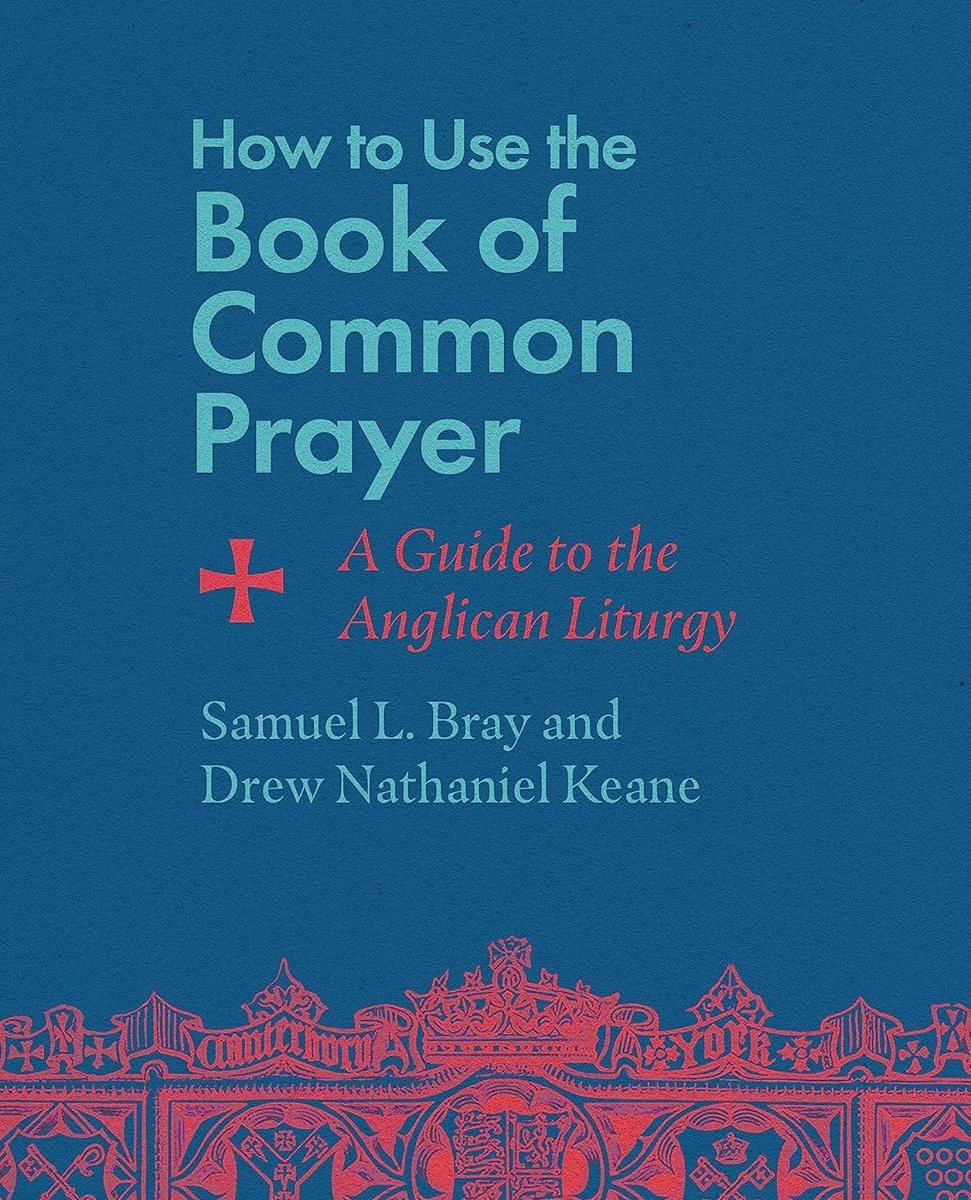
By Samuel Bray and Drew Nathaniel Keane | Amazon.com | 192 pages
Published in February of 2024
SUMMARY: At over 600 pages the 1662 Book of Common Prayer can be daunting. Where does one start? Samuel Bray and Drew Nathaniel Keane in How to Read the Book of Common Prayer have penned a passionate and deeply insightful guide to one of Christianity’s most enduring treasures. The book deftly weaves history, theology, and practical application to show why the Book of Common Prayer (BCP) remains relevant, not just as a liturgical tool but as a wellspring of Christian devotion. The author’s love for the BCP is evident on every page, offering readers not just information but a heartfelt invitation to embrace its rhythms and teachings.
From the outset, the authors lay a compelling foundation for liturgy as a spiritual discipline. The duo dismantle the myth that liturgy stifles authenticity, emphasizing instead its ability to connect believers across pews, centuries, and continents. Liturgical prayers, they argue, provide words when we are at a loss, build unity through shared faith, and cultivate a deep-seated seriousness about worship. Through liturgy, we are not left to grope for words but are given “words to say when we have none.”
The opening chapter also highlights the beauty and practicality of learning these prayers by heart, making them accessible during life’s most profound moments—from the mundane (walking or driving) to the sacred (sitting with a dying friend). As the authors eloquently put it, “What we memorize and meditate on will change us, becoming part of who we are.” Liturgy is not an obstacle to heartfelt worship but a tool for anchoring it in Scripture, tradition, and community.
Chapter 2 explores the BCP’s history, emphasizing its revolutionary role in unifying English worship. Archbishop Thomas Cranmer’s work in crafting the original 1549 prayer book is described as both courageous and groundbreaking. Translating Latin liturgies into English, Cranmer sought to democratize worship, ensuring that “common prayer” was truly accessible to all. The BCP, the book reminds us, was more than a liturgical manual; it was a tool for proclaiming the gospel, filled with Scripture and structured to move hearts from repentance to renewal.
Chapters 3 and 4 explore the heart of the BCP—Morning and Evening Prayer and the creeds. These daily offices are described as nourishment for the soul, offering not bursts of spiritual intensity but a steady, dependable framework for encountering God. Their simplicity and structure help believers move through confession, praise, Scripture reading, and prayer, leaving them in a place of grace and peace.
The discussion of the creeds is equally compelling. By reciting these ancient declarations, Christians affirm not only their individual faith but also their belonging to the universal church. The Athanasian Creed, in particular, is presented as a masterclass in theological precision, encapsulating the doctrines of the Trinity and the Incarnation with enduring clarity.
Chapter 8 offers a rich exploration of the Christian liturgical calendar. The authors note that the church year “is not a relic of the past but a vibrant rhythm for worship and spiritual growth.” The book beautifully explains the dual cycles of the year—the Nativity Cycle, beginning with Advent, and the Easter Cycle, beginning with Lent. The authors compare the church’s feasts and fasts to time capsules, reminding us annually of God’s mighty works.
The book’s treatment of sacraments is both theologically rich and pastorally practical. Baptism and communion are described as “outward signs of inward spiritual grace.” The author explains that baptism is not merely a rite of passage but a profound moment of turning to God. Similarly, communion is presented not as a ritual but as a divine encounter requiring preparation and reverence.
The book concludes with a call to embrace the BCP as a lifelong companion: “You never need to move on or leave it behind.” It encourages readers to find others to pray with, reminding us that the Christian life is meant to be lived in community. The authors beautifully tie this to the concept of the “communion of saints,” quoting a Lutheran theologian: “The lives of the saints… are a reminder of the continuing existence of the body of Christ—the Church—and of the fact that whether it be militant and on earth or triumphant and in heaven, it is one, holy, catholic church, timeless and composed of God’s people in every age.”
How to Read the Book of Common Prayer is a must read for those dipping their toes in the BCP. With clarity, historical depth, and theological acumen, the authors present a compelling vision of how this ancient text can shape the hearts and lives of believers today.
KEY QUOTE: “The [Book of Common Prayer] is designed to proclaim the gospel persuasively. It manages the hearers’ encounter with the divine word in several ways: first using the Scriptures to prompt self-examination in order to hammer away at our hard hearts; then using the Scriptures to offer broken and contrite hearts the balm of the gospel; and finally using the Scriptures to point faithful hearts to appropriate ways of responding to the gospel (such as praise, prayer, good works, almsgiving, and feasting at the Lord’s table).”
BONUS: The Book of Common Prayer is available for free online at bcponline.org and bookofcommonprayer.net which we prefer as it easier to follow and have links to the daily offices.
BONUS II: Listen to the authors discuss the BCP on The Laymen’s Lounge.
DID YOU KNOW? Sunday to Saturday has a Good Reads page where we post all of the books we have read – even the ones that didn’t make the cut.
Our latest curated books on prayer:

BOOK: What If Jesus Was Serious About Prayer?
What if prayer wasn’t a thing you put on your to-do list to knock off, but a practice you continually perform throughout every aspect of your life? What if prayer isn’t about communication with God, but communion? What if praying to God and its effectiveness has nothing to do with our devotion? Through 53 devotionals,…
Read more
BOOK: Common Prayer Pocket Edition: A Liturgy for Ordinary Radicals
For those looking to dip their toe into a liturgical calendar and historical prayers, Common Prayer Pocket Edition: A Liturgy for Ordinary Radicals by Shane Claiborne and Jonathan Wilson-Hartgrove is a perfect introduction. The 11-page introduction succinctly explains why a book of common prayer is useful while quickly orienting the reader on how to use…
Read more
BOOK: Every Moment Holy: Vol. 1 (pocket edition)
A beautiful book full of liturgies for individuals, couples, families, and congregations for any occasion including the mundane (the washing of windows) to the celebratory (leaving on a holiday) to the sorrowful (insoluble homesickness ) and everything in between (sleeping in tents). Douglas Kaine McKelvey has a knack for the right words for any situation.
Read more Sunday to Saturday