Our Father in heaven,
Matthew 6:9-11 (NIV)
hallowed be your name,
your kingdom come,
your will be done,
on earth as it is in heaven.
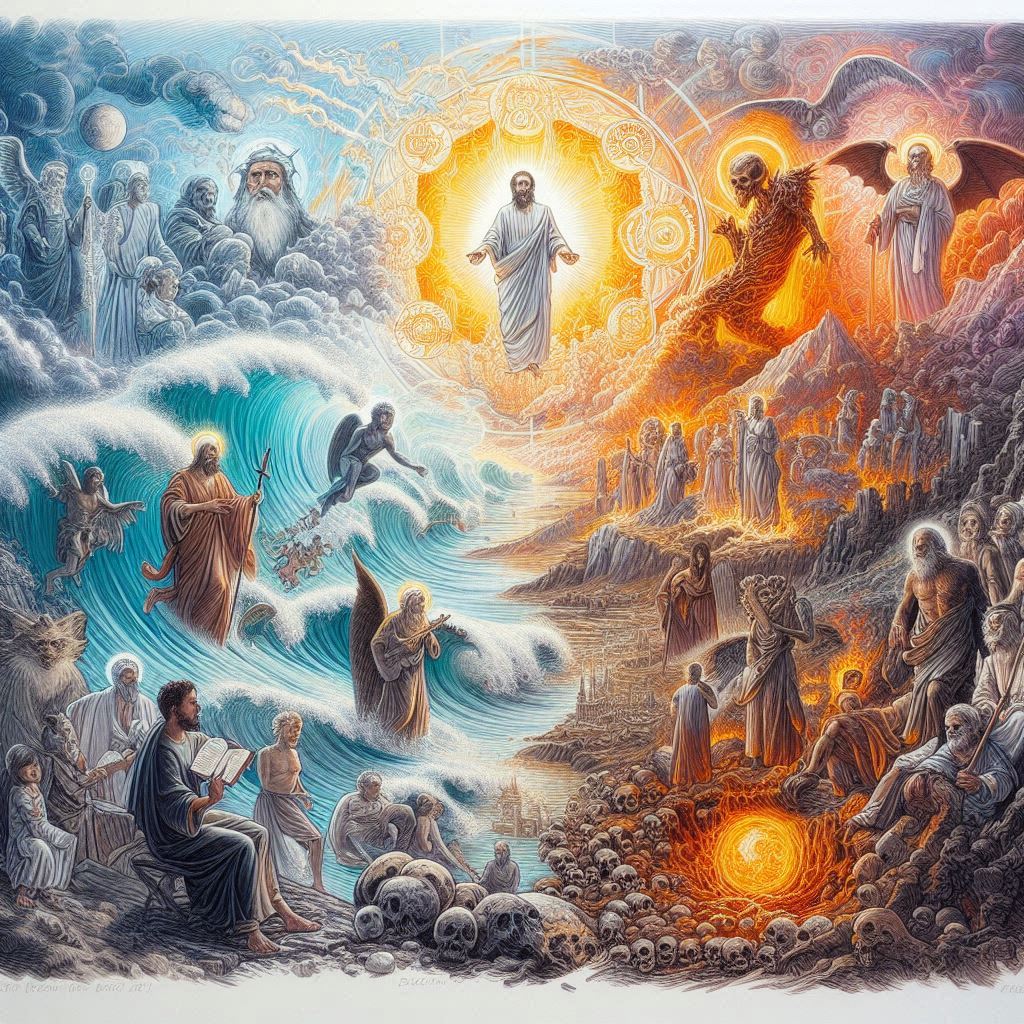
CHRISTIAN ESCHATOLOGY IS the study of what the Bible says will happen in the end times. Sometimes this topic can be divisive, but as you will learn respected and thoughtful Christian theologians from across the ages have landed in various eschatological camps. There are four common eschatologies: amillennialism, dispensationalism (shortened from dispensational premillennialism), historic premillennialism, and postmillennialism. The main distinction between the four is the interpretation of Revelation of 20:1-10 and the millennium.
Even though many Christians may not be able to name which eschatological camp they fall into, they most certainly fall into one. And that eschatological worldview shapes how a Christian interacts with the world, views God, and views God and his relationship with creation and his people. For example, how many Christians view the modern state of Israel is a germane example of how one’s end-time theology shapes one’s views of world events. Many Christians view the establishment of the Israeli state in 1948 as a fulfillment of Old Testament prophecy. Others believe that the church is the new Israel with no borders.
With that said, Christians can get lost in the eschatological weeds. One’s end-time theology, as long as we love God and our neighbors and treat everyone with dignity and respect because they are made in God’s image, is not a first-tier issue. In fact, the four views agree on more issues than disagree. For instance, all agree that the Bible is the word of God and that Jesus has come and will come again.
As pastor John Mckenzie says, we should not explore eschatology with the question, ‘Which one is right?” but with “Why does this matter?” Ultimately our job is to be a witness and not to interpret dates and times.
Therefore, faithful Christians can have differing views on the end times. In fact, author and pastor Dayton Hartman says, “Believers are free to disagree about eschatological matters…We must define points of agreement that represent the far reaches of orthodoxy and then be willing to admit that what lies beyond those shores of sure things are simply speculative things.”
| Millennium view | Church and Israel | Role of Satan | Rapture Timing | Revelation 19 and 20 | |
|---|---|---|---|---|---|
| AMILLENNIALISM | Believes that there is no literal or visible 1,000-year earthly reign of Christ; interprets the Millennium symbolically; believes in the already and the not yet kingdom; where the Church experiences both victory and suffering | Unified view; the Church inherits the promises made to Israel; the Church is spiritual Israel | Satan himself is not presently exerting influence over the world as he has been bound by Christ | During the second coming | Events are not chronological |
| DISPENSATIONALISM M | Believes that there is a literal 1,000-year reign of Christ; Christ returns before the millennium | Sharp distinction; the church is not Israel and Israel is not the church | Satan is currently active in the world, but will be bound before the millennium | Pre or mid tribulation | Events are chronological |
| HISTORIC PREMILLENNIALISM | Believes that there is a literal 1,000-year reign of Christ; Christ returns before the millennium | Unified view; the Church inherits the promises made to Israel; the Church is spiritual Israel | Satan is currently active in the world, but will be bound before the millennium | During the second coming | Events are chronological |
| POSTMILLENNIALISM | Believes that there is no literal or visible 1,000-year earthly reign of Christ; the world becomes more and more Christian and then Christ returns after the millennium | Unified view; the Church inherits the promises made to Israel; the Church is spiritual Israel | Satan himself is not presently exerting influence over the world as he has been bound by Christ | During the second coming | Events are not chronological |
COMMON DEFINITIONS
Millennium – a 1,000 year period of Christ reigning referred to only one time in the Bible (Rev. 20:3); different eschatologies differ on the time of Christ’s return; different eschatologies differ on a literal or figurative reign
Rapture – the belief that Christians will be taken from earth to heaven while unbelievers will remain on earth; Biblical passages that are used to justify this view include Matthew 24:40-41 and 1 Thessalonians 4:13-18
Second coming – when Christ returns to earth; all eschatologies believe in the second coming of Christ
Tribulation – a period of worldwide suffering, persecution, and disasters typically divided into two 3.5-year periods; not all eschatologies believe in a tribulation; Matthew 24, Revelation 20
PROPHECY VIEWS
Adjacent to the eschatological views are four ways to view prophecies in the Bible. The views are futurism, idealism, historicism, and pretermism. These views are not tied to any specific eschatology but are incorporated into several of the views. For more information read Eschatology 101: The Book of Revelation.
Futurism – the majority of the prophecies are in the future (premillenials, dispenstationals, amillenials)
Historicism – tries to make historical events out of the prophecies in the Bible (dispensational)
Idealism – an allegorical view of the prophecies (amillenials)
Pretermism – the majority of the prophecies have already been fulfilled (postmillenials, amillenials)
READ
READ: Survey of Eschatological Views / Gregory Brown
A succinct introduction to four Christian eschatological views complete with key Biblical passages and some history.
LISTEN
LISTEN: Eschatology 101: The Return of Christ / Reformation Baptist Church
Pastor Cole Shinall of Reformation Baptist Church (Centerton, AR) warns that, while studying eschatology is important, one can never know the full truth of Christ’s second coming. Therefore, it is paramount to head into end-times conversations with a healthy dose of humility and grace.
WATCH
WATCH: The End Times 01: Eschatology 101 / John Mckenzie
Pastor John Mckenzie of Hope Fellowship (Frisco, TX) provides an easy-to-understand introduction into four Christian eschatologies while cautioning Christians not to be afraid of studying the end times, to be cautious with prophetic predictions, and to hold perspectives loosely. He recommends coming into the conversation humbly while realizing that no one knows which interpretation is correct.
DIG DEEPER
READ: Jesus Wins / Dayton Hartman
In Jesus Wins, Pastor Dayton Hartman makes his position clear: speculative discussions about the end times rarely offer any value and should never become a point of division. He emphasizes that as long as believers adhere to the foundational doctrines expressed in the Apostles‘ and Nicene Creeds, their specific views on eschatology (the study of the end times) should not fracture the church’s unity.
LEARN: Your Kingdom Come: The Doctrine Of Eschatology / thirdmill
A five-part in-depth video series on the doctrine of eschatology with study guides.
QUOTES
“Your beliefs about God’s eternal purposes and what will happen in the future form your image of God, and we will ultimately act in the way we imagine God acting.” Peri Zahnd, “A Christian Perspective on the Israeli-Palestinian Conflict” BrianZahnd.com, 28 March 2015, https://brianzahnd.com/2015/03/christian-perspective-israeli-palestinian-conflict/
“The cross is not just the message of the kingdom, the cross is the means of the kingdom. The trouble with a lot of popular eschatology is that it assumes Jesus did not win through the cross and resurrection, and will have to resort to something other than the way of the cross to accomplish His purposes in the world.” Jonathan Martin, “On Israel, the Church, and the Politics of Jesus” PastorJonathanMartin.com, 27 November 2012, https://web.archive.org/web/20140716035217/http://pastorjonathanmartin.com/uncategorized/on-israel-the-church-and-the-politics-of-jesus/
More curated media on eschatology:

LEARNING CAPSULE: Memento Mori
Learn about Memento Mori and how a Christian can integrate the philosophy into everyday life.
Read more
MOVIE: Praying for Armageddon
While many viewers will focus on the Christian nationalism in Praying for Armageddon, the pertinent issue that the film explores, but perhaps does not articulate, is how a Christian eschatological view can influence how an individual views global conflict, the state of Israel, politics, and world events in light of Biblical prophecy.
Read more
 Sunday to Saturday