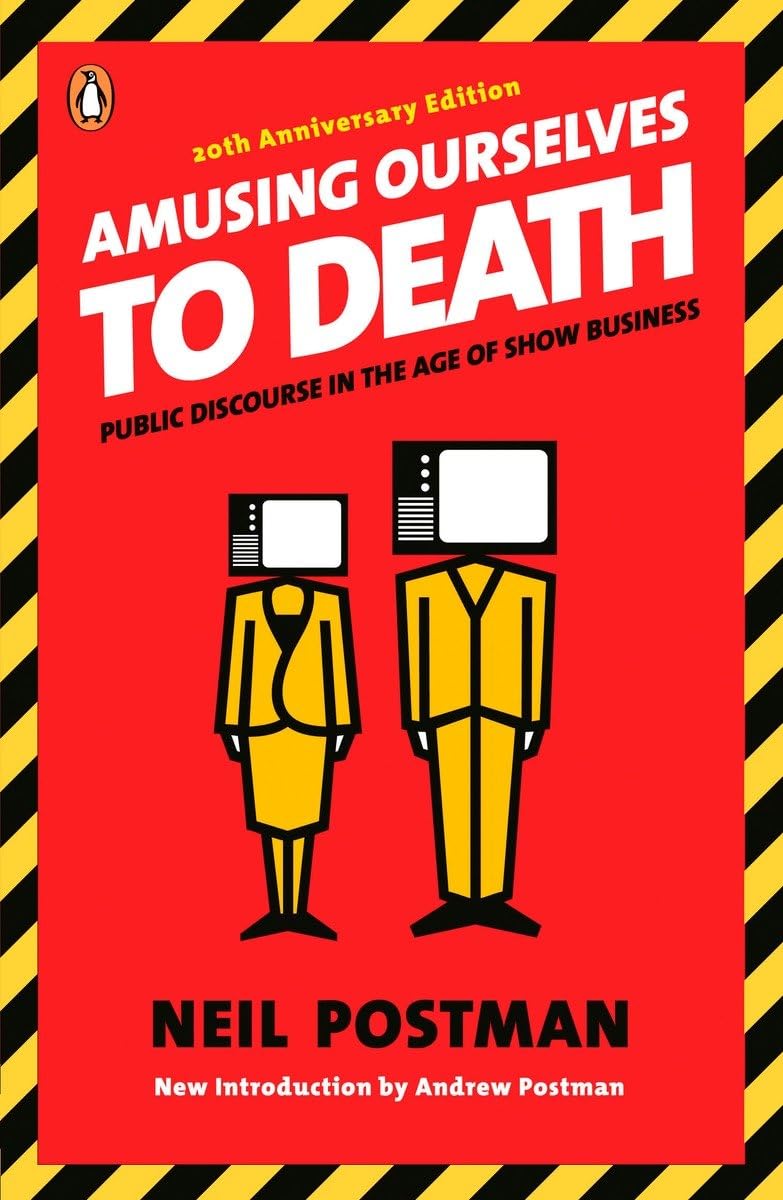
By Neil Postman | Amazon.com | 208 pages
Published in December of 2005
SUMMARY: In Neil Postman‘s Amusing Ourselves to Death, the author delves into the ways in which television and other forms of visual media have transformed public discourse, diminishing the role of the written word and fostering a culture where entertainment prevails over serious intellectual engagement. Postman begins with a provocative question: “Is it really plausible that this book about how TV is turning all public life (education, religion, politics, journalism) into entertainment… Can such a book possibly have relevance to you and The World of 2006 and beyond?” This question sets the stage for an exploration of how media shapes not just the content but the very nature of communication in society.
Postman argues that “our politics, religion, news, athletics, education, and commerce have been transformed into congenial adjuncts of show business, largely without protest or even much popular notice.” The implications of this shift are profound: we are, as Postman puts it, “a people on the verge of amusing ourselves to death.” The focus of the book is on the forms of public discourse and how these forms regulate and dictate the kinds of content that emerge from them. For Postman, the medium is indeed the message, as he asserts that “each medium, like language itself, makes possible a unique mode of discourse by providing a new orientation for thought, for expression, for sensibility.”
Postman traces the origins of this transformation to the advent of the telegraph, which introduced a new kind of public discourse characterized by fragmented, decontextualized information. He notes that “the telegraph made a three-pronged attack on typography’s definition of discourse, introducing on a large scale irrelevance, impotence, and incoherence.” The telegraph, and later the photograph, paved the way for a media environment where “the picture forced exposition into the background, and in some instances obliterated it altogether.” This shift in focus from words to images has had a lasting impact on how we understand and engage with information.
One of the most striking aspects of Postman’s analysis is his assertion that television has become “the command center of the new epistemology (study of knowledge).” Unlike other forms of media, television encompasses all forms of discourse, shaping public understanding of politics, education, religion, and more. “Television does not extend or amplify literate culture,” Postman warns, “It attacks it.” The medium’s inherent biases—toward entertainment, simplicity, and the visual—have led to a situation where “television empties itself of authentic product information so that it can do its psychological work.”
Postman concludes by reflecting on the broader implications of a society dominated by visual media. He echoes the concerns of earlier thinkers like Aldous Huxley, suggesting that “the Western democracies will dance and dream themselves into oblivion” rather than being overtaken by force. In a culture where “disinformation… means misleading information—misplaced, irrelevant, fragmented or superficial information,” the line between truth and lies becomes blurred, and public discourse is reduced to mere entertainment.
Despite being a secular Jew, Postman has much to say about screen based media’s affects’ on religion. Instead of being a counter cultural space, for the most part, many American evangelical churches have embraced screens and theatrics with little critical thought. What was once a sacred space has been transformed into a place of entertainment and spectacle.
“Religion, like everything else, is presented, quite simply and without apology, as an entertainment. Everything that makes religion an historic, profound and sacred human activity is stripped away; there is no ritual, no dogma, no tradition, no theology, and above all, no sense of spiritual transcendence. On these shows, the preacher is tops. God comes out as second banana.”
Postman is onto something here. Church attendance is declining and people are lonely. Perhaps some of that has to do with how we have fashioned church in America. Most churches have uncritically embraced the latest technology whether it be large screens with colorful graphics or phone apps. Worship oftentimes feels like a concert while sermons are sometimes superficial and one sided. Instead of blaming the popular cultural issue of the day, perhaps the church should take a look inward and ask if we have been complicit in the decline of church attendance because, partly, we have embraced religion as entertainment leading to a shallow faith.
While Amusing Ourselves to Death is not a Christian book there is much to glean from this 1985 classic and is highly recommended for lay people in addition to pastors or anyone in a position of authority within a church.
KEY QUOTE: “Television (screen based media) is different because it encompasses all forms of discourse. No one goes to a movie to find out about government policy or the latest scientific advances. No one buys a record to find out the baseball scores or the weather or the latest murder. No one turns on radio anymore for soap operas or a presidential address (if a television set is at hand). But everyone goes to television for all these things and more, which is why television resonates so powerfully throughout the culture. Television is our culture’s principal mode of knowing about itself. Therefore—and this is the critical point—how television stages the world becomes the model for how the world is properly to be staged. It is not merely that on the television screen entertainment is the metaphor for all discourse. It is that off the screen the same metaphor prevails.”
DID YOU KNOW? Sunday to Saturday has a Good Reads page where we post all of the books we have read – even the ones that didn’t make the cut.
More curated content:

BOOK: The Faithful Spy
John Hendrix’s The Faithful Spy is an engrossing and visually arresting account of Dietrich Bonhoeffer—a German pastor whose fierce moral clarity led him into the heart of a conspiracy to resist, and ultimately assassinate, Adolf Hitler.
Read more
BOOK: The Ragamuffin Gospel
The Ragamuffin Gospel is not so much a theological treatise as it is a wake-up call—one delivered gently but insistently to the soul that keeps trying to earn what Christ has already given. Manning’s premise is simple: most Christians do not actually believe in the incomprehensible, unearnable grace of God. We nod politely at grace…
Read more
LEARNING CAPSULE: Thanksgiving
America’s origin story is deeply tied to Thanksgiving and the Pilgrims. Unfortunately much of what we have been taught in school is not true. Below are our favorite resources to relearn Thanksgiving.
Read more Sunday to Saturday