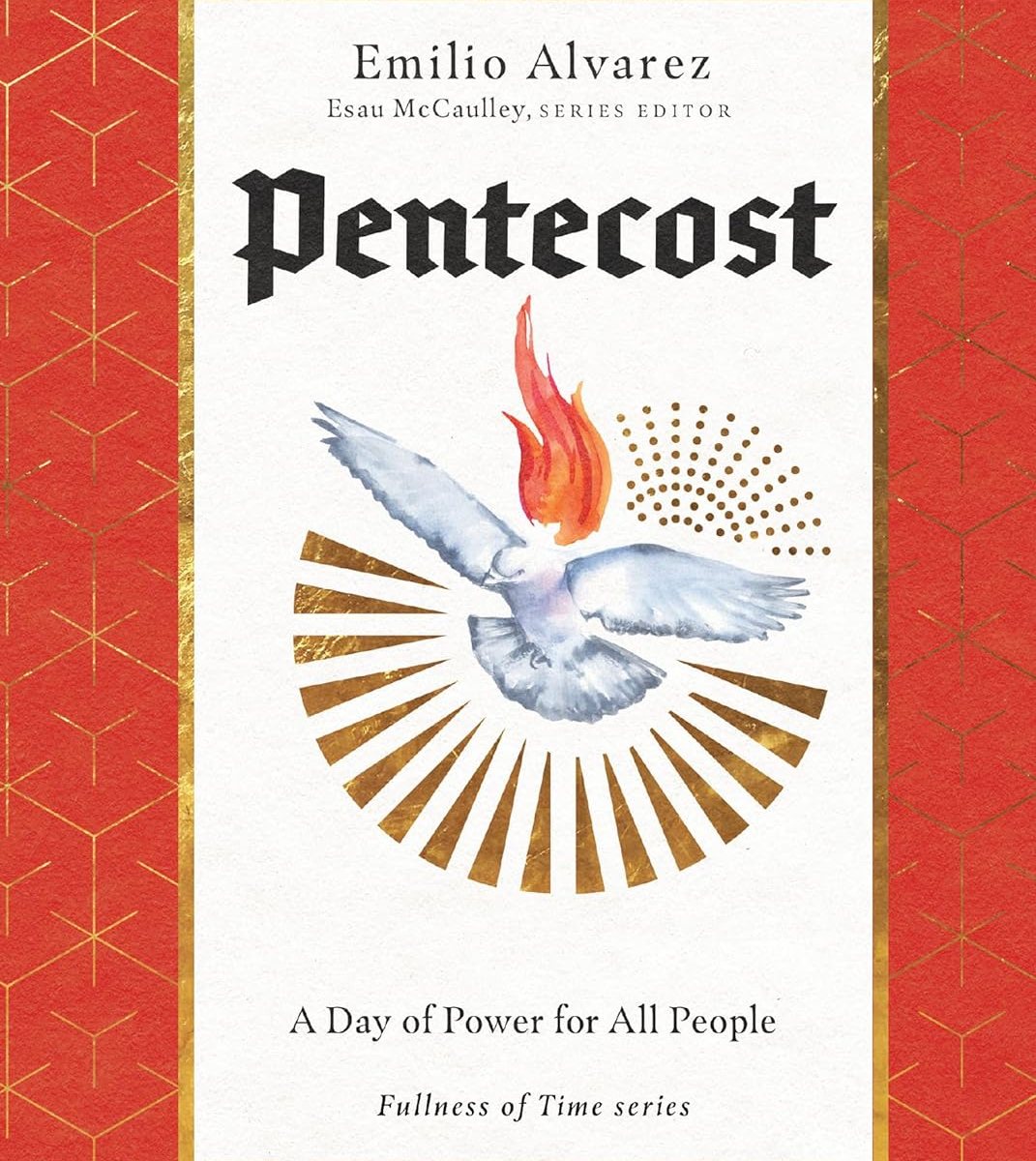
By Emilio Alvarez | Amazon.com | 144 pages
Published in April of 2023
SUMMARY: Is Pentecost about spiritual gifts and power? Or is it about unity? Perhaps it is the birth of the church? Pentecost, which means fifty days, is all of those things and more. In Pentecost – A Day of Power for All People bishop of the Union of Charismatic Orthodox Churches Emilio Alvarez details the themes, rituals, prayers, and hymns from a variety of denominations of this often misunderstood day on the church calendar.
Pentecost, which occurs 50 days after Easter, is the oldest season on the church calendar. Most Christians have heard of Pentecost and many likely associate the celebration with spiritual gifts, particularly speaking in tongues, but the celebration is more than one day and not just about speaking in tongues.
It is the only festival where the Israelites were “commanded to count the days leading up to the actual feast (Leviticus 23:15-16; Deuteronomy 16:9).” Traditionally, no kneeling or fasting occurred during the 50 days as the time leading up to the celebration was used to prepare spiritually for the celebration. In fact, this is where the title for this series, The Fullness of Time (preparation), is taken from (Galatians 4:4-5).
“It is a time when we intentionally slow down and consider living not in the future to come or the past that was but in the day-to-day present that is,” Alvarez writes.
Alvarez stresses that Christians should look at the season of Pentecost not as tourists who “travel with an attitude of entitlement,” but as pilgrims who travel as an exercise in “humility, dedication, and faith.”
“Pentecost is a time where we will take each of the fifty days to travel closer and closer to the God who dwells in our hearts,” Alvarez says. “We are inspired as Christian believers to take this journey day by day, equipped with our own personal experiences, biblical stories, Scriptures, prayers, and, yes, even symbolic rituals.”
Part of the journey of Pentecost includes reading Acts 2 where the Holy Spirit rests on the apostles. Many modern Christians associate Pentecost with the charismatic Pentecostal denomination and while Alvarez is proudly part of a Pentecostal church he is quick to highlight that Acts 2 is not a story about people speaking gibberish, but about the unifying nature of Pentecost. Of people from different cultures hearing the word of God in their own language.
“At Pentecost, the languages that were spoken brought unity in horizontal relationships with others as well as vertical relationship with God.”
Alvarez extends the unifying nature of Pentecost to speaking the language of other denominations. While his first denominational language is Pentecost, he is also able to speak Eastern Orthodox, Catholic, or Anglican.
“While everyone has a first language of Christian spirituality or faith (be it Roman Catholic, Methodist, Anglican, Pentecostal, or Orthodox), the Spirit on the day of Pentecost propels believers to go beyond their established language of faith into an empowered, multilingual experience of Christian spirituality,” Alvarez writes. “If we are all one church and indeed the body of Christ, then Pentecost brings us together.”
Alvarez demonstrates the diversity of Pentecostal celebrations by including Syrian Orthodox, Anglican, Roman Catholic, and other denomination’s rituals, prayers, and hymns in chapter 4. While the colors (Eastern Orthodox uses green while Roman Catholic uses red), hymns (Syrian Orthodox kolos (hymns) focus on the supernatural and mystical power of the Holy Spirit while Anglican hymns do not) or rituals (Pentecostal believes in the baptism of the Holy Spirit while other denominations do not) may differ there is something from every denomination that Christians from all over the world can use and learn from.
“Not only does Pentecost empower us to be culturally and ecclesially multilingual it also restores the communal sensibility that should be at the forefront of our celebration of Pentecost,” Alvarez writes. “Pentecost is communal, not individual, empowerment.”
Of note, while we enjoyed Pentecost we found the main theme of the book muddled when compared to the other books in the Fullness of Time series. Perhaps this is due to our unfamiliarity with the season of Pentecost or perhaps this was Alvarez’s intention, but it is worth noting.
KEY QUOTE: “The actual day of Pentecost celebrates the descent of the Holy Spirit (Acts 2:1-13), the recapitulation (retelling) of the historic promise of the Spirit, the retelling of the great gospel story (Acts 2:24-39), and the growth of the church in the power of the Spirit (Acts 2:40-47).”
WATCH: Watch Alvarez discuss his book on the Thrive Podcast.
OF NOTE: Pentecost is part of The Fullness of Time series in which six authors provide an introduction to a season of the church year (Advent, Christmas, Epiphany, Lent, Pentecost, and Easter).
DID YOU KNOW? Sunday to Saturday has a Good Reads page where we post all of the books we have read – even the ones that didn’t make the cut.
Our latest curated media on the church calendar:

BOOK: Epiphany – The Season of Glory
Most Christians are familiar with the liturgical seasons of Advent, Christmas, and Lent while fewer are acquainted with Epiphany. In Epiphany – The Season of Glory Episcopal priest Fleming Rutledge simply, compellingly, and theologically explores the significance of the Epiphany season by highlighting and revering the divine glory of God before exploring the four themes…
Read more
BOOK: Christmas – The Season of Life and Light
In many parts of the world it is effortless to get lost in the consumerism and busyness of Christmas. As a result, some people looking for deeper meaning cynically reject the celebration of Christmas. In Christmas: The Season of Life and Light Anglican priest Emily Hunter McGowin says not so fast as she frames Christmas…
Read more
BOOK: Advent – The Season of Hope
From chocolate to Lego and everything in between Advent calendars begin filling store shelves come November. This often consumeristic celebration of Advent divorced from its 4th-century roots neglects the heavier themes of waiting, hope, darkness, light, repentance, rest, emptiness, and filling. In a world that equates December with yuletide debauchery and commercial frenzy, Tish Harrison…
Read more Sunday to Saturday