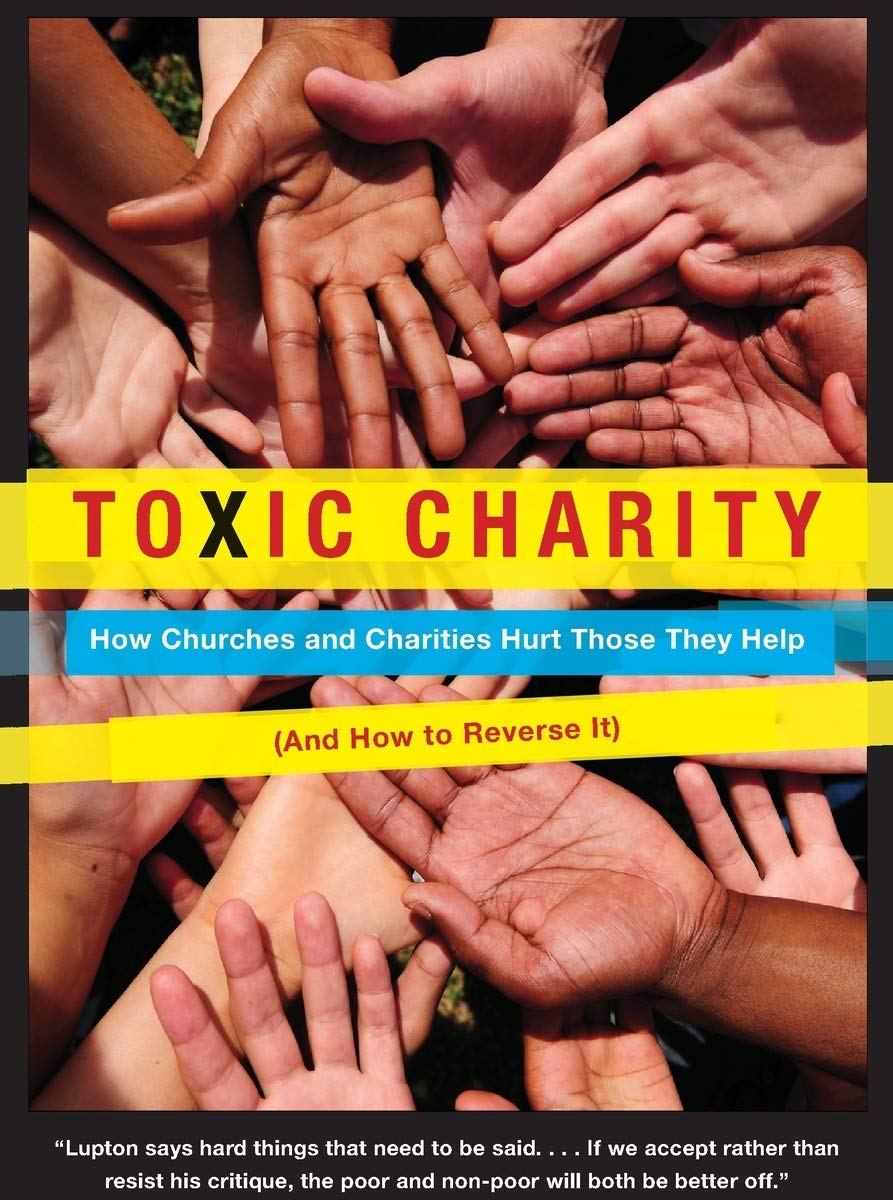
By Robert Lupton | Amazon.com | 208 pages
Published in October of 2012
SUMMARY: Over two billion dollars are spent, and more than two million Christians go on short-term mission trips each year. in the last 60 years, more than two trillion dollars have been sent to Africa while Haiti has received over $13 billion in foreign aid ($5 billion from the United States) in the last 13 years. Despite the influx of billions of foreign aid and charity dollars along with millions of volunteers most of the people in Africa, Haiti, and other developing countries still live in poverty. The tendency of parachurch organizations, non-governmental organizations (NGOs), and nonprofits to slowly, or never, pivot from crisis relief to long-term development in conjunction with the propensity of short-term mission workers having a giver-receiver mindset leads to what author Robert Lupton calls toxic charity, which also happens to be the title of his book.
“When relief does not transition to development in a timely way, compassion becomes toxic,” Lupton writes.
Often the desire to help the poor comes from a compassionate heart–and this is a good thing. “It’s that imprint of the divine, the essential attribute of our humanness, that impels us to reach out, even sacrificially, to help another in distress,” Lupton says. And yet, compassionate giving can wreak havoc on poor communities. The free handouts eventually create entitlement and dependency. In fact, Lupton has a theory that says, give once and you elicit appreciation, give twice and you create anticipation, give three times and you create expectation, give four times and it becomes entitlement, and give five times and you establish dependency.
“Again and again we are finding that when it comes to global needs in organizational development and human development, the granting of money creates dependence and conflict, not independence and respect,” Lupton pens.
In short, it is easy to throw money at a situation or do a one-off short-term mission trip, but what the poor need is a long-term partner who will work with them and not for them.
“Doing for rather than doing with those in need is the norm. Add to it the combination of patronizing pity and unintended superiority, and charity becomes toxic,” Lupton writes.
The sobering reality is that churches that run charities and go on short-term mission trips need to prayerfully and considerately reevaluate how they approach these tasks. For far too long many churches, with good intentions, have participated in charity work for the church’s benefit and not for the people they are serving.
“Mission trips have value. They open up new worlds, new perspectives, new insights. They expose us to fascinating cultures, connect us with new friends, allow us to experience God at work in surprising ways, inspire us, break our hearts, and build camaraderie among traveling companions. Any one of these benefits might well justify the time and expense. But isn’t it time we admit to ourselves that mission trips are essentially for our benefit?”
To avoid the common traps of toxic charity Lupton created a code of conduct, patterned after the Hippocratic Oath, called the Oath for Compassionate Service. This seven-point document includes oaths such as empowering the local community, listening to local community members, and limiting one-way giving. The document is an excellent starting point for churches and short-term mission tripgoers to discuss and commit to before engaging in short-term mission trips or charity work.
The most effective framework to help the poor, according to Lupton and When Helping Hurts authors Steve Corbett and Brian Fikkert (another excellent book on charity/short-term missions), is asset-based community development (ABCD). The four-step framework works side by side with the Oath of Compassionate Service by working with and listening to the communities one is trying to help.
“It’s an empowering philosophy that begins with the strengths (not problems) that poor communities already have and then builds upon those strengths,” Lupton writes. “Also important, community development resists anything that would undermine the building of indigenous capacity. Enabling the poor to create their own solutions is obviously a much slower process than fixing problems for them—painfully slow for high-capacity friends with resources who would effect a quick ‘cure.'”
The ABCD philosophy is a long-term, community-led rather than volunteer-led approach that is “designed to transform the poor, their families, and their communities in sustainable and holistic ways.”
Above all, Lupton says volunteer workers must listen as it builds trust and respect while giving poor people dignity.
“The best way to assure effectiveness is to spend enough time as a learner, ask enough questions, and seek wisdom from indigenous leaders to gain an accurate picture of both existing realities and future aspirations of the community,” Lupton says.
Toxic Charity is a must-read for any church, organization, or individual who has participated in charity work or short-term mission trips. The book can help Christians approach short-term mission trips with greater awareness, humility, and a commitment to truly making a positive difference in the lives of those they seek to serve.
KEY QUOTE: “If there is one takeaway message that this book can offer to those in service work or supporting it, it is this: the poor, no matter how destitute, have enormous untapped capacity; find it, be inspired by it, and build upon it.”
BONUS: Listen to Lupton discuss his philosophy in a sermon at Christ Presbyterian Church (Edina, MN).
NEXT READ: If you liked Toxic Charity, try When Helping Hurts next where Steve Corbett and Brian Fikkert get into the details of asset-based community development. The two books combined provide a solid foundation to build a sustainable, dignity-based approach to charity work.
DID YOU KNOW? Sunday to Saturday has a Good Reads page where we post all of the books we have read – even the ones that didn’t make the cut.
More curated content:

BOOK: The Faithful Spy
John Hendrix’s The Faithful Spy is an engrossing and visually arresting account of Dietrich Bonhoeffer—a German pastor whose fierce moral clarity led him into the heart of a conspiracy to resist, and ultimately assassinate, Adolf Hitler.
Read more
BOOK: The Ragamuffin Gospel
The Ragamuffin Gospel is not so much a theological treatise as it is a wake-up call—one delivered gently but insistently to the soul that keeps trying to earn what Christ has already given. Manning’s premise is simple: most Christians do not actually believe in the incomprehensible, unearnable grace of God. We nod politely at grace…
Read more
LEARNING CAPSULE: Thanksgiving
America’s origin story is deeply tied to Thanksgiving and the Pilgrims. Unfortunately much of what we have been taught in school is not true. Below are our favorite resources to relearn Thanksgiving.
Read more Sunday to Saturday