
By Eugene Cho | Amazon.com | 272 pages
Published in March of 2020
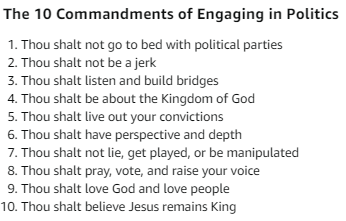
SUMMARY: Politics matter. Politics matter because policies affect people. Policies affect Christians and non-Christians alike as they shape the community we live in. But, where does a Christian start politically? How does a Christian engage, advocate, and debate in the public sphere? What does the Bible have to say about politics? With humor and grace and a nod towards the Ten Commandments Eugene Cho in Thou Shalt Not Be a Jerk lists 10 “thou shalts” a Christian should follow when engaging in the public sphere.
Cho begins with the argument that many American Christians have capitulated to the culture and are being shaped by a political party more than the reading of the Bible in community. This cultural or superficial Christianity, what some are labeling the CINO’s (Christians In Name Only), have manifested itself in the label’s Christian or evangelical being an identity marker for a specific political belief system rather than a counter cultural movement consisting of self sacrificing Jesus followers.
“The crux of our dilemma is that for some Christians, we’ve allowed our politics to inform our theology rather than our theology and worship of the Christ informing our politics,” Cho says.
This partially helps explain the rise in Christian Nationalist rhetoric that is largely devoid of traditional Christian values and why, despite the six fold in the last 50 years of Americans claiming no religion, the number of people who identify as evangelical has increased from 16% in 2008 to 50% in 2018.
“‘Cultural ‘Christianity’ has bowed to political loyalties. It’s neither radical nor countercultural in the way of Jesus. Rather, it’s a bastardized and infected form of cultural Christianity. Another word for what I just described is idolatry,” Cho writes.
Thus Cho’s first thou shalt is “Thou Shalt Not Go to Bed with Political Parties.” In our current cultural context it is easy to pick on the Republican party, but the Democratic, or any other party for that matter, have their own issues. It is not wrong to affiliate with a political party, but it must never become our ultimate allegiance and we must never vote in lockstep with a political party.
“Even if one affiliates with a particular party, may we maintain a posture to collaborate, listen, hold accountable, and engage the political system all while understanding that the political system is not our ultimate hope or answer,” Cho says. “In addition, we must never lose the courage or conviction to speak prophetically to a group of people because we are lured by the power associated with politics, a leader, or a political party.”
Jerks for Jesus. Unfortunately. it’s not hard to imagine a self-proclaimed Christian wearing a t-shirt with this slogan proudly. Cho’s second chapter, “Thou Shalt Not be a Jerk” is a call for Christians to treat everyone, especially those they disagree with, with dignity and respect–to fully embrace the doctrine of the image of God. We must never dehumanize. Never call people names. This is the bare minimum for Christians.
Cho references Jim Daly‘s, head of Focus on the Family, advice when engaging with other people. We should be asking, and then actively listening, to people to help us understand what they believe and what brought them to those conclusions.
“To devalue the life of another, to be a jerk, is counter to the kingdom. To be a jerk, to revel in earthly shouting matches, sells short the radically different way of Christ. It’s a poor representation of Christianity and also a foolish political move. Before all of our best arguments, let’s first show love.”
The subsequent chapters feed off of the first two. Cho touches on listening first which provides the opportunity to build bridges with your neighbors, friends, and family. Throughout the book he touches on humility. The humility to listen first. The humility to be introspective about our beliefs and biases. The humility to dig in and be informed before opening our mouths. The humility to give thought to what we say and how we say it and the humility to evaluate whether we are being manipulated by a political party.
“In order to live the kingdom way of living, we must routinely question our mind-sets and, certainly, our hearts too. We must remind ourselves again and again of the way of God, which is usually different from the way of the world. Without remembering what Christ taught us, without constant introspection, we shortchange the power of God’s work in and through us.”
The final three chapters focus on what actions to take to be politically engaged. Cho aptly starts with prayer as it is “the ultimate antidote to our propensity to dehumanize and vilify others.” He also suggests focusing on local civic engagement as it is an easy way to serve one’s neighbors. Importantly, we should advocate for the poor, the vulnerable, and the oppressed. This includes the unborn, the immigrant, the refugee, the widow, and the poor.
“Don’t just cast a vote. Embody your faith. Serve your neighbors. Advocate for the last and the least. Share the gospel. Work for the common good. Pursue justice. Seek the peace of your city.”
Practically this could looked like participating in the MADA (made America dinner again) movement where a host provides dinner and guided, respectful conversation with 6-10 other people who have differing political viewpoints. Ultimately, no matter what path a Christian chooses to participate in civically we need to remember one thing, “‘Whoever becomes President, Jesus remains King.‘”
Thou Shalt Not Be A Jerk shares many parallels between Compassion (&) Conviction (our top pick for learning about being a Christian and engaging with politics), but with personal stories and humor, but minus the basic American government lesson. We recommend reading them back to back as they complement each other by reinforcing many of the same talking points, but from different perspectives.
KEY QUOTE: “It is impossible to have one party that fully encapsulates what it means to be about the kingdom of God. It doesn’t exist. The kingdom of God cannot be encapsulated by one gender, one church, one denomination, one leader, and certainly not by one political party.”
LISTEN: Listen to Cho discuss his book with Skye Jethani on The Holy Post Podcast (skip to 31:32 to get to the interview).
DID YOU KNOW? Sunday to Saturday has a Good Reads page where we post all of the books we have read – even the ones that didn’t make the cut.
Our latest curated books on the politics:

BOOK: The Liturgy of Politics
Reflect on your average day and consider the routines, rituals, and practices you follow. These daily habits—what you spend your time on, the media you consume, and the people and places you engage with—compose a personal liturgy of life. This liturgy shapes you both politically and spiritually, often without being critically examined. In The Liturgy…
Read more
BOOK: Compassion (&) Conviction
Many Christian American voters are tossed about by their ideological political party as they lack a framework for engagement. Instead of the Bible dictating a Christian’s politics, partisan politics dictate what Christians go to the Bible for. For Christians, this should not be so. In Compassion (&) Conviction, Justin Giboney, Michael Wear, and Chris Butler…
Read more
BOOK: The Ballot and the Bible
Despite the decline in American church attendance quoting the Bible in the public square still holds cultural sway. Each year presidential hopefuls reference Matthew 5 and the city on a hill while those whose political party is in power appeal to Romans 13. One of the most recent egregious examples happened in June of 2020…
Read more Sunday to Saturday