
By Rachel M. MacNair, Stephen Zunes | Amazon.com | 208 pages
Published in April of 2008
SUMMARY: What links abortion and euthanasia? War and poverty? The death penalty and embryonic research? Racism and environmental damage? Violence. Specifically violence against human beings. Through a collection of excerpts from books, journals, articles, and speeches Consistently Opposing Killing focuses on the key tenets of the consistent life ethic (CLE), details some of the history of the movement, and provides a way to talk about the CLE with others.
“We are moved by…the ‘consistency thing’ — the belief that respect for human life demands opposition to abortion, capital punishment, euthanasia, and war. We don’t think we have the luxury or the right to choose some types of killing and say that they are all right, while others are not. A human life is a human life; and if equality means anything, it means that society may not value some human lives over others,” says Mary Meehan in one of the opening essays.
The anthology is divided into 19 easy-to-digest chapters and split into two parts – connected violence and connected solutions. The authors in the connected violence section link all of the seemingly disparate subjects concerning life calling attention to the violence each of the issues subject humans to. The authors are clear that you cannot be an advocate of the CLE if you are pro-war, but anti-abortion or pro-abortion, but anti-war.
“If we do not protect this right for everyone, it is not guaranteed for everyone, because anyone can become weak and vulnerable to assault,” Meehan says in an excerpt from an article she penned in 1980.
Although one does not have to read the book linearly, we found the first half of the book particularly compelling as each chapter builds on the previous one. Despite discussing complex issues, the chapters are short and easy to understand. The first half is a fantastic introduction to the history (such as why CLE advocates, generally, are in a conservative party) and beliefs of the movement.
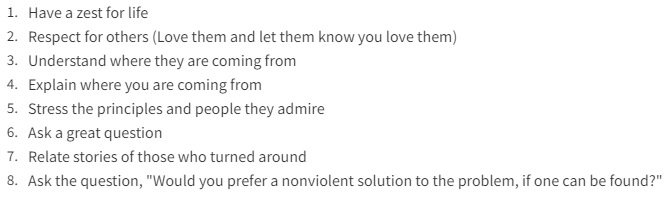
The second half of the book pivots to how people can work to promote and discuss the CLE with others while pointing to the many examples in human history of successful non-violent change and resistance. Chapter 14 is beneficial as it lists eight tips (see below) on conversing with someone.
For the most part, the authors in Consistently Opposing Killing do not come from a religious background. However, we firmly believe the integration of the doctrine of the Imago Dei strengthens the CLE argument. For a look at the CLE with a Christian background, we recommend Resisting Throway Culture by Charles Camosy or Consistently Pro-Life by Rob Arner.
While we do not recommend Consistently Opposing Killing for an introduction to the CLE, for that we recommend Rehumanize by Aimee Murphy, it is an important read to further one’s understanding of the history and implications of following this ethic.
KEY QUOTE: “A human life is a human life; and if equality means anything, it means that society may not value some human lives over others.”
DID YOU KNOW? Sunday to Saturday has a Good Reads page where we post all of the books we have read – even the ones that didn’t make the cut.
More curated books on the consistent life ethic:

BOOK: Consistently Pro-Life
If you asked a random person who identified as a Christian what a Christian ethic of life is or what the basic tenants of a consistent ethic of life are they would likely focus on abortion for the first question and not be able to answer the second question. Author Rob Arner, in Consistently Pro-Life:…

BOOK: Rehumanize
The vast majority of humanity tolerate some form of violence towards their fellow human beings. We are pro-abortion, but anti-death penalty or pro-war, but anti-euthanasia. There is a distinct lack of consistency in our value of life. In Rehumanzie Aimee Murphy does a marvelous job of explaining the values and origins of the consistent life…

BOOK: Resisting Throwaway Culture
What would the world look like if Christians, and non-Christians, lived a life focused on a culture of hospitality and encounter? What if we rejected the pervasive consumerist culture that sees humans, especially the poor and the vulnerable, as commodities to be used? Professor of Medical Humanities at the Creighton University School of Medicine Charles…
 Sunday to Saturday