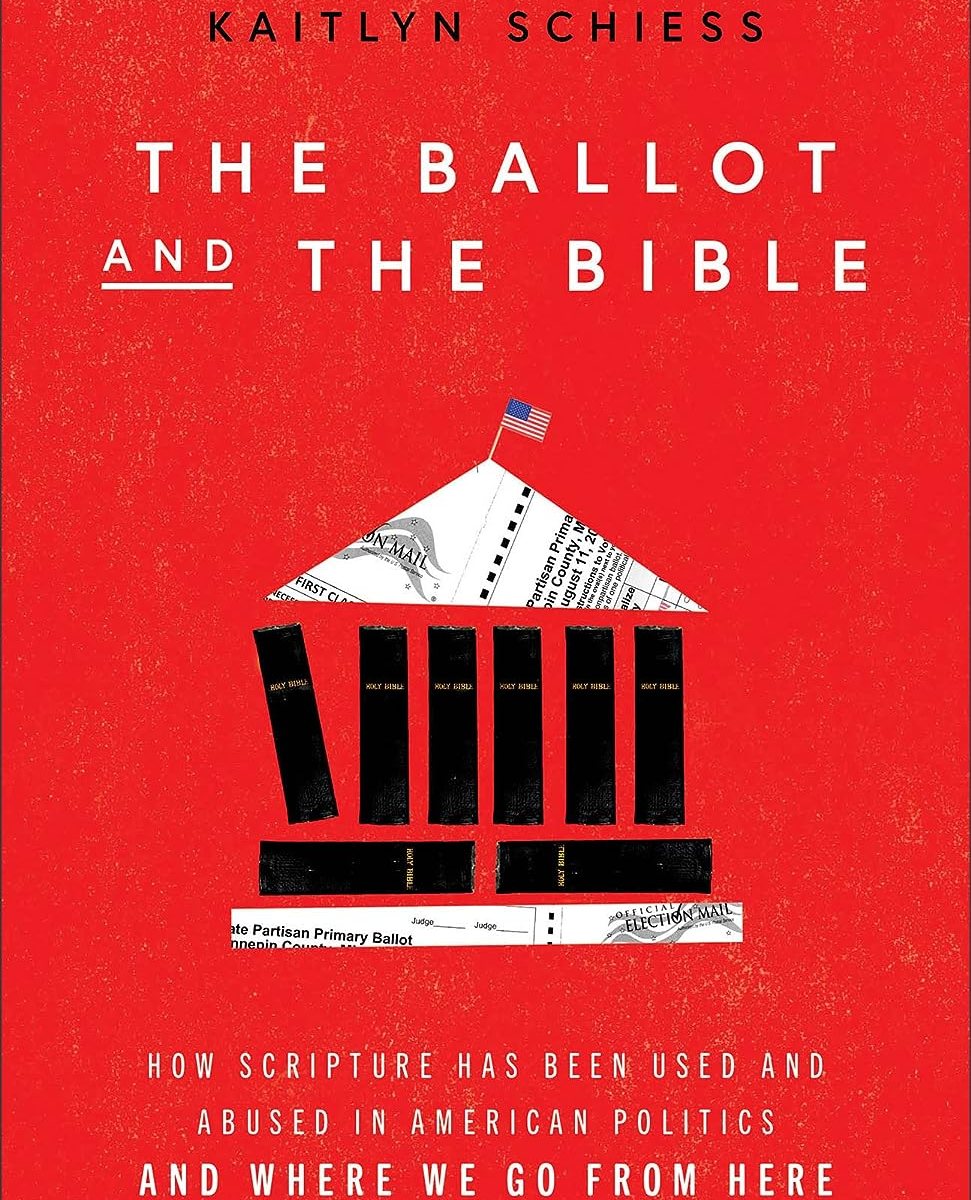
By Kaitlyn Schiess | Amazon.com | 224 pages
Published in August of 2023
SUMMARY: Despite the decline in American church attendance quoting the Bible in the public square still holds cultural sway. Each year presidential hopefuls reference Matthew 5 and the city on a hill while those whose political party is in power appeal to Romans 13. One of the most recent egregious examples happened in June of 2020 when President Donald Trump posed in front of St. John’s Church in Washington D.C. with a Bible in hand for an awkward photo-op. When asked if the Bible was his he replied, “It’s a Bible.” These examples show people using the Bible, and it’s cherry-picked verses, as political props–and it’s been happening since the beginning of the United States. In The Ballot and the Bible Kaitlyn Schiess asks us to peer through the lens of traditional and contemporary American history to examine how Americans have used the Bible for both good and bad in the public sphere while asking the reader to examine their own tendencies to manipulate the Bible for their own political beliefs.
“Biblical language is powerful. It gives our words a sense of transcendence and moral obligation—and that can be easily abused,” Schiess pens.
Before diving into the historical record Schiess aptly, and continually, points out that no person reading the Bible comes to it as a blank slate. This is true of the Puritans in the 1600s and true of Americans in the 21st century. We are formed by our upbringing, what we read, what we listen to, what we watch, and what we have experienced in life. Therefore as we look to the Bible for answers to today’s political questions we need to have the humility to be aware of our blind spots, prejudices, and our current culture context that is shaping us.
“When we come to biblical texts looking for political instruction, we are never coming as blank slates,” Schiess writes. “We bring our cultural and political contexts, our theological systems, and our own questions, needs, and desires. This is not necessarily a bad thing, but it can be dangerous if left unexamined.”
This lack of examination “might be the besetting sin of American political theology,” Schiess says. Instead of Christians letting the Bible dictate their politics many go to the Bible looking for verses to justify their political positions. This approach facilitates taking verses out of context, using the Bible as an identity marker, claiming blessings and curses that were not meant for us, and using the Bible to browbeat our perceived opponents.
Schiess begins her historical examination with Massachusetts Bay colony governor Jon Winthrop who penned a sermon in the 1630s suggesting that his colony was divinely called to be a “city upon a hill” in the New World. Winthrop took the blessings and curses intended for Israel or the church from Matthew 5 and applied them to the Massachusetts Bay colony. After three hundred years of his sermon being lost to history, President-elect John F. Kennedy reintroduced the slogan to the American public in a 1961 speech as America grappled with the Cold War and the rise of communist atheists. President Ronald Reagan cemented the phrase into American politics during the 1980s. Since then almost every sitting U.S. president has used the city upon a hill phrase
“The ‘city upon a hill’ image exemplifies a common problem: we pluck promises of provision or judgment that were given to Israel or the church and apply them wholesale to America,” Schiess writes. “We misapply promises because we misunderstand who is being addressed. We are often narcissistic and nationalistic readers, seeing our own nation as the subject of every promise or command.”
One of the most commonly abused chapters that is taken out of context is Romans 13. When divorced from the overarching narrative of the Bible the passage is used as a tool to scare and intimidate people into obeying the government. It is conveniently deployed when one’s preferred political party is in power and deftly forgotten when one’s preferred political party is not in power. Slave owners used it to justify slavery, anti-Civil Rights people used it to justify telling people not to protest, and loyalists to the British government used it to condemn the revolutionists. The misinterpretation and cherry-picking continues in modern times as those who did not like the Black Lives Matter protests in the 2020s referenced the chapter.
The main point is that “Romans 13:1–7 does not provide a clear application to all Christians in all times and places,” Schiess says. “Rather, it gives a general exhortation as to the posture Christians should have toward governing authorities. These seven verses, rather than offering a complete Christian theory of government, exhort believers to recognize their various obligations to others, including obligations that take distinctly political forms…obligations that prioritize the common good of others above individual rights.”
Besides the city on a hill reference and Romans 13 Schiess explores how the Bible was used, for good and bad, in the Civil War and the Civil Rights movement, the Cold War, and by Trump and Evangelicals. While it easy to judge those in the past, the myriad examples from history of people using the Bible as a prop and cherry-picking Bible verses should prompt us to examine our own hearts. When we hear a politician or leader quote a Bible verse, how does it make us feel? “Do you feel as if your team has scored some points? Do you feel responsible to correct when it is misused? Does it more strongly shape your politics than how loosely and conveniently it seems to shape national politics?”
The next time you hear a politician or leader reference a Bible verse crack open your Bible. Read the entire book, or at the very least, the chapter where the verse came from. Ask: who was the book written to? What was the context when the book was penned? Scripture is a living document which means it does not mean the same thing to all people at all times.
“Different political circumstances—different times and places, with different histories and moral questions—will require different biblical emphases, and knowing what passage is fitting for any given moment will require wisdom, the guidance of the Holy Spirit, and the assistance of the whole communion of saints (both our neighbors now and the witness of Christians throughout global history),” Schiess says.
Ultimately, The Ballot and the Bible is a call for Christians to dig into the full canon of Scripture, individually, and, perhaps more importantly, communally where different perspectives are present. It is a call to examine our own culture context and how it affects our reading of the Bible.
“When we’ve done the hard work of thinking about what God requires of human communities, rulers, and citizens—looking at the whole Bible for guidance, learning what Christians before us and beside us have done, incorporating the wisdom we can gain from sociology, history, and political theory—we will be more prepared to address the problem in front of us.”
KEY QUOTE: “We are a Bible-haunted nation. How we respond is of crucial importance: Will we champion the unique power, authority, and distinctive narrative of Scripture to motivate political work, or will we continue to halfheartedly cheer when a politician gives the Bible a PR boost?”
LISTEN: Do have time to read the book? Listen to Schiess discuss her book on the Dangerous Dogma podcast.
DIG DEEPER: Download the study guide from Baker Publishing.
DID YOU KNOW? Sunday to Saturday has a Good Reads page where we post all of the books we have read – even the ones that didn’t make the cut.
Our latest curated books on the politics:

BOOK: The Liturgy of Politics
Reflect on your average day and consider the routines, rituals, and practices you follow. These daily habits—what you spend your time on, the media you consume, and the people and places you engage with—compose a personal liturgy of life. This liturgy shapes you both politically and spiritually, often without being critically examined. In The Liturgy…
Read more
BOOK: Thou Shalt Not Be a Jerk
Politics matter. Politics matter because policies affect people. Policies affect Christians and non-Christians alike as they shape the community we live in. But, where does a Christian start politically? How does a Christian engage, advocate, and debate in the public sphere? What does the Bible have to say about politics? With humor and grace and…
Read more
BOOK: Compassion (&) Conviction
Many Christian American voters are tossed about by their ideological political party as they lack a framework for engagement. Instead of the Bible dictating a Christian’s politics, partisan politics dictate what Christians go to the Bible for. For Christians, this should not be so. In Compassion (&) Conviction, Justin Giboney, Michael Wear, and Chris Butler…
Read more Sunday to Saturday