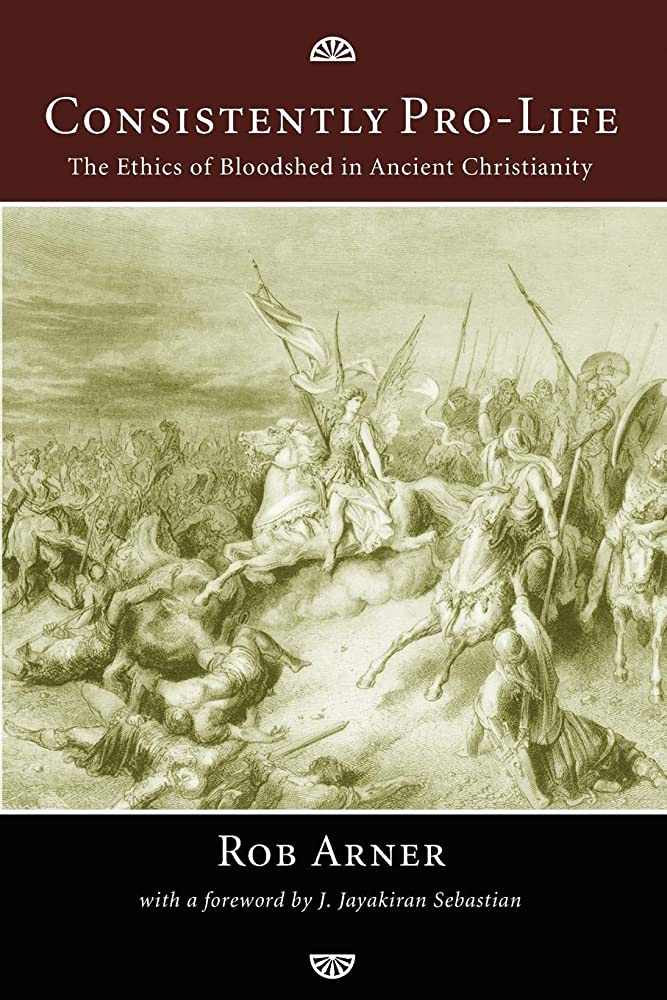
By Rob Arner | Amazon.com | 154 pages
Published in June of 2010
SUMMARY: If you asked a random person who identified as a Christian what a Christian ethic of life is or what the basic tenants of a consistent ethic of life are they would likely focus on abortion for the first question and not be able to answer the second question. Author Rob Arner, in Consistently Pro-Life: The Ethics of Bloodshed in Ancient Christianity, hypothesizes that, in general, modern Christians’ approach towards the ethic of life has been “sloppy, ad hoc, and piecemeal at best” and that the ancient church has a blueprint for how to approach the ethic of life in modern times.
“This is a book about killing. Specifically, when and under what circumstances is it morally justifiable to take human life? Even more specifically, what moral demands might the gospel of Jesus Christ make upon those whom Christ has called to take up the cross and follow him, with respect to the taking of human life?”
For too long when Christians are faced with an ethical decision instead of asking, “Which course of action is most consistent with my identity as a disciple of Jesus Christ?” or “What does God require of me?” We have asked, “‘What is the most effective way to achieve the ends I desire?’ Or, put less cynically, ‘How can we most efficiently transform the world for God?’ In other words, many modern Christians have tended to prioritize effectiveness over faithfulness.”
This inconsistent philosophy hurts the church’s witness, is unfaithful to the scriptures, and leads to hypocrisy. One of Arner’s goals in writing Consistently Pro-Life is to show the interconnectedness between abortion, the death penalty, euthanasia, and other issues associated with life.
To demonstrate how piecemeal our ethic of life is, the author walks through three scenarios and the justifications people give for the killing of an unborn child in the womb, abortion doctors, and the murderers of abortion doctors. Arner states that each person in each group would oppose killing the majority of the time, but their pro-life stance is “conditional and contingent.”
“For advocates of abortion, killing the child in the womb is justifiable provided that it is done for the betterment of the life of the mother. For proponents of ‘defensive action’ killing an abortion doctor is permissible as long as the goal is to defend the innocent life in the womb. And for those who stress the violence of the state, killing is permissible provided it is done by one endowed with ‘legitimate authority’ for the purpose of defending life.”
Arner argues that the debate is not about whether killing is right or wrong “but under which conditions it is morally permissible to kill? Each group accuses the others of hypocrisy and inconsistency while warding off similar charges by the others. What would it take to achieve some moral consistency?”
Using the writings of the ancient church fathers such as Tertullian and Lactantius in addition to observations from Roman officials, Arner details the remarkably consistent way early Christians approached life.
The early church believed that all humans were made in the image of God and therefore had infinite worth and value. They demonstrated this by adopting babies left in garbage dumps and caring for the poor, the disabled, the enslaved, and the sick. This was a subversive stance.
“Christians who followed the way of Jesus just did not kill. Rather than confining the term ‘pro-life’ into the narrow issue of abortion as we do today, the church consistently rejected killing—whether in the womb, in the arena, on the battlefield, or anywhere else.”
Instead of bifurcating issues like modern Christians do, the ancient Christians valued all life at all stages even going so far as to set limitations on what a Christian could and could not do in the military. In fact, there are no surviving orthodox Christian writings from the pre-Constantine era that approves of Christians participating in killing. Their extraordinarily consistent view on life set them apart from the rest of the culture resulting in many converts and, also, persecution. This consistent view of life is what Arner says we should strive for again.
“The early church consistently opposed the killing of human persons, and…the discipline and moral clarity of the ancient Christians (on issues of violence, at least) can show us a new way forward in a time of polarizing culture wars.”
Thus, as Christians, we are called to operate in an entirely different way than the rest of the world. We should be anti-abortion, anti-death penalty, anti-euthanasia, and anti-war. Arner believes a consistent ethic of life will not only lead to peace and healing but also serve as a beacon of hope and a witness that the kingdom of God is manifesting itself on earth.
“The renunciation of violence by faithful followers of Jesus thus serves a crucial apologetic purpose in establishing the truthfulness of Christian claims,” Arner writes. “If the church of Jesus Christ is living without war and violence, then the prophecy is fulfilled. Without this embodied peace in the Christian community, such apologetic claims are destroyed and Christian claims about Jesus’ messiahship lose their credibility.”
KEY QUOTE: “The consistent ethic of life of the gospel of Jesus is, I contend, neither ‘liberal’ nor ‘conservative,’ for it cuts across all human ideological distinctions, challenging all to uphold the dignity and value of each human person from conception to death.”
BONUS: Listen to Arner discuss the historically consistent ethic of life on the Centrally Speaking podcast.
DID YOU KNOW? Sunday to Saturday has a Good Reads page where we post all of the books we have read – even the ones that didn’t make the cut.
More books on the consistent life ethic:

BOOK: Consistently Opposing Killing
What links abortion and euthanasia? War and poverty? The death penalty and embryonic research? Racism and environmental damage? Violence. Specifically violence against human beings. Through a collection of excerpts from books, journals, articles, and speeches Consistently Opposing Killing focuses on the key tenets of the consistent life ethic (CLE), details some of the history of…
Read more
BOOK: Rehumanize
The vast majority of humanity tolerate some form of violence towards their fellow human beings. We are pro-abortion, but anti-death penalty or pro-war, but anti-euthanasia. There is a distinct lack of consistency in our value of life. In Rehumanzie Aimee Murphy does a marvelous job of explaining the values and origins of the consistent life…
Read more
BOOK: Resisting Throwaway Culture
What would the world look like if Christians, and non-Christians, lived a life focused on a culture of hospitality and encounter? What if we rejected the pervasive consumerist culture that sees humans, especially the poor and the vulnerable, as commodities to be used? Professor of Medical Humanities at the Creighton University School of Medicine Charles…
Read more Sunday to Saturday