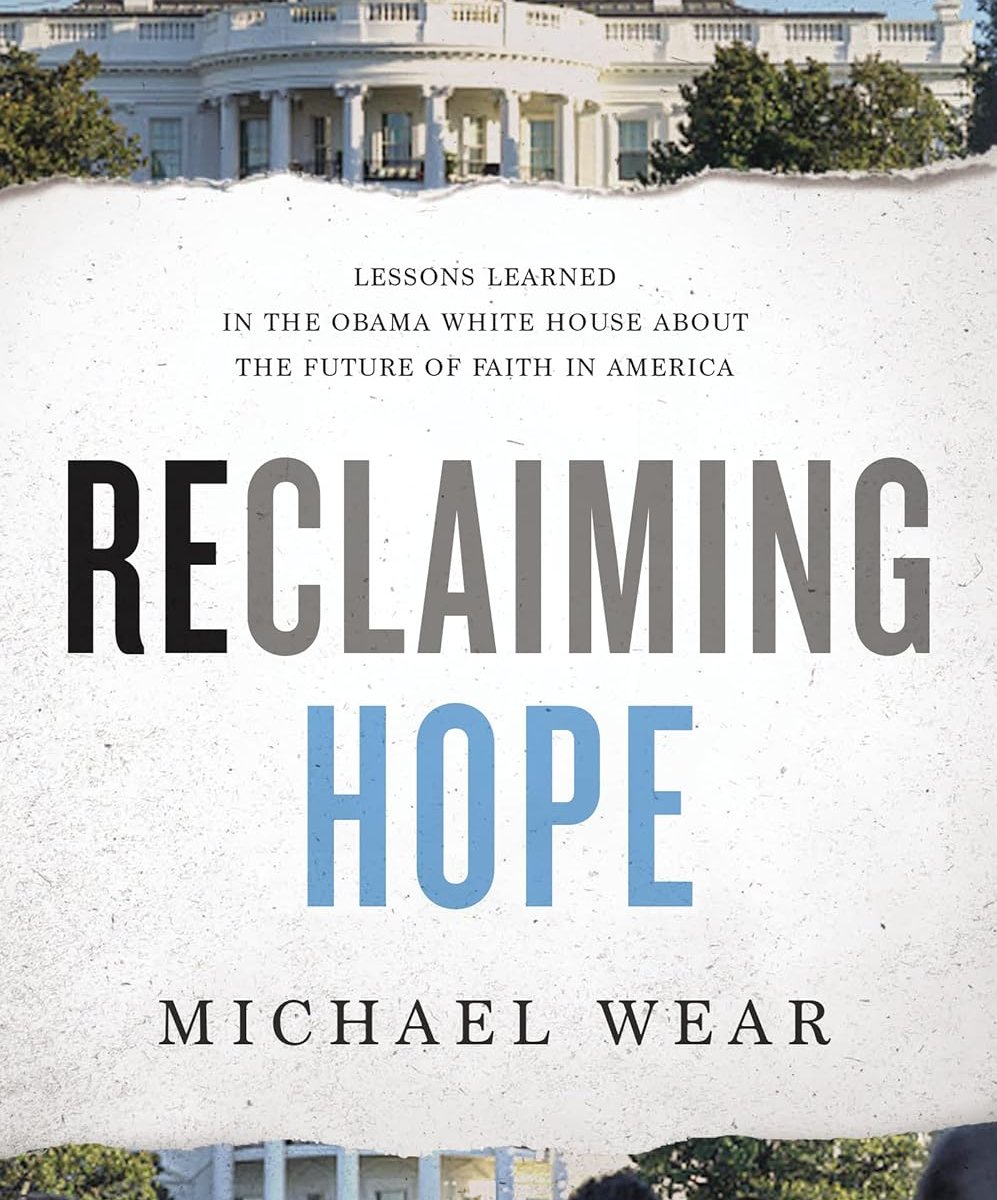
By Michael Wear | Amazon.com | 304 pages
Published in January of 2017
SUMMARY: In the introduction to Reclaiming Hope Michael Wear provides a fitting definition of reclaim which includes recovering a wasteland. Most Americans, no matter where they stand on the political spectrum, would agree that our current political climate is a wasteland. The means always justify the ends–especially if it humiliates and defeats the opponent. Compromise is blasphemy. Partisanship is king. Simply put elected officials and the voting public have lost hope.
“Our moral imaginations have shrunk. Our self-confidence, nagged by the suspicion that what we need most might be outside ourselves, has limited our capacity to dream,” Wear writes.
Reclaiming Hope is part memoir and part theological exhortation for Christians to get involved in politics. Wear details his time working for Barak Obama‘s administration where he helped get the Illinois United States Senator elected in 2008 and then worked for the president as a staffer for faith outreach for four years. Wear candidly discusses the highs and lows of working for the Obama administration. He details the negotiations, the lessons learned, the emotional highs and the lows, the frustrations, and the friendships forged.
Unlike many political memoirs, Wear does not focus on bashing former colleagues. Nor does he have any salacious stories. Wear admires Obama and is proud of the work he did during his time, but he does not hold back on where the administration tripped up. It is a forthright glimpse into the inner workings of an administration from the vantage of one of the many staffers who keep the wheels of government moving.
Wear recalls a handful of times during Obama’s first term when the hope was palpable. For example, the Obama administration started an initiative to work with leaders from a variety of faiths to help kids in foster care. Through the program, the program was able to cut the number of kids in foster care in half. And yet Wear, although not explicitly stating it, started to lose hope during the campaign to reelect Obama in 2012. The hopeful feeling and willingness to compromise from the first election campaign was gone replaced with partisanship and a desire to win no matter the cost. Wear places part of the blame on “data drive politics”– a feature of our current political climate that is wreaking havoc on voters across the United States.
“Data-driven politics is incompatible with aspirational politics,” Wear writes. “It is willing to sacrifice a broader coalition for a few bucks, a dozen hours of free airtime, and an angrier base.”
At the end of 2011 when he is finished his work with the Obama administration, he finds himself in his favorite restaurant in Washington D.C. reflecting on what he experienced. One feels that Wear is on the precipice of taking a step back from politics. And yet he finds hope, not in the Obama administration or the Democratic party, but in the hope of Jesus and his coming kingdom, and this hope propels him to stay involved in politics.
In the final chapter, Wear makes a strong argument for Christians to get involved in politics. He argues that it is not only our civic duty but is a tangible way to put our faith into action by loving our neighbor. As Christians, we simply do not have the option to disengage. In fact, Wear believes that Christians should stay involved in the Democratic or Republican parties as being involved in a political party is the most effective way to get our voice heard and can help temper the extremes on each side.
“In a two-party system of government, in a party-based system of government of any kind, to become an independent is to check out of the system,” Wear argues. “It is to unilaterally disarm, to give up one of the primary levers we have as citizens to influence our political system. Withdrawal is not a prophetic message that those in power ought to shape up. They are not listening. Your voice is not heard when you don’t show up.”
So, whether you are beat down and a Republican, disenfranchised and an Independent, or frustrated and a Democrat, Wear implores Christians of all political persuasions to show up and hope.
“Hope is always reclaiming; it is always transforming that which was a wasteland, which was previously thought unfit for use, into something that can be cultivated, which can yield a harvest. When the pundits and prognosticators say we should withdraw, that there is no way forward, hope gives us the eyes to see new possibilities. It is this new vision, a gift from hope, that will allow us to see our politics anew.”
Hope is a commitment to the political process. Hope is pursuing justice rooted in the image of God and love of neighbor. Hope is engaging with humility and respect. Practically this means voting, writing a letter/e-mail to your representatives, volunteering, and investing time, money, and talent in political advocacy organizations.
“Withdrawal from politics and our political parties is not the answer. The Republican Party needs now more than ever Christians advocating from within for a position, for example, on immigration reform that respects human dignity and takes the consequences of deportation on families seriously. The Democratic Party needs now more than ever Christians advocating from within for a recognition, say, that abortion is not a moral good, that it is not how a just society addresses unintended pregnancies, and that a respect for human dignity and a sense of protecting the vulnerable extends to those not yet born.
“The Christian’s duty is the same as every citizen: to affirm what is good and speak out against that which is not.”
KEY QUOTE: “Christians have an obligation to be involved in politics, but we do not belong to our politics. Since our identity is not found in our politics, we are freed up to pursue unlikely alliances, consider other points of view, and love our political enemies. In hope and humility, we can partner with and learn from people of different faiths, backgrounds, an ideological perspectives and across racial boundaries. Hope opens these doors. Hopeful politics are inclusive, because hope is open to possibility. We look for it everywhere.”
LISTEN: Don’t have time to read the book? Listen to Wear talk about Reclaiming Hope on the Make it Simple Podcast.
LIKE WHAT WEAR HAS TO SAY? Sign up for his newsletter and/or listen to his Wear We Are podcast with his wife, Melissa.
DID YOU KNOW? Sunday to Saturday has a Good Reads page where we post all of the books we have read – even the ones that didn’t make the cut.
Our latest curated books on the politics:

BOOK: The Liturgy of Politics
Reflect on your average day and consider the routines, rituals, and practices you follow. These daily habits—what you spend your time on, the media you consume, and the people and places you engage with—compose a personal liturgy of life. This liturgy shapes you both politically and spiritually, often without being critically examined. In The Liturgy…
Read more
BOOK: Thou Shalt Not Be a Jerk
Politics matter. Politics matter because policies affect people. Policies affect Christians and non-Christians alike as they shape the community we live in. But, where does a Christian start politically? How does a Christian engage, advocate, and debate in the public sphere? What does the Bible have to say about politics? With humor and grace and…
Read more
BOOK: Compassion (&) Conviction
Many Christian American voters are tossed about by their ideological political party as they lack a framework for engagement. Instead of the Bible dictating a Christian’s politics, partisan politics dictate what Christians go to the Bible for. For Christians, this should not be so. In Compassion (&) Conviction, Justin Giboney, Michael Wear, and Chris Butler…
Read more Sunday to Saturday