
By Aimee Murphy | Amazon.com | 292 pages
Published in July of 2022
SUMMARY: The vast majority of humanity tolerate some form of violence towards their fellow human beings. We are pro-abortion, but anti-death penalty or pro-war, but anti-euthanasia. There is a distinct lack of consistency in our value of life. In Rehumanzie Aimee Murphy does a marvelous job of explaining the values and origins of the consistent life ethic (CLE) while showing the interconnectedness of issues associated with life. For example, the amount of money America spends on the military directly affects how much we contribute to fight poverty. Another example is the same drugs that are used in abortions are used in euthanasia.
The first chapter alone is worth the price of the book as Murphy clearly and succinctly touches on the history of the movement, where self-defense fits in, key definitions and facts, the origins and roots of the philosophy, and why the CLE is for everyone.
“The (consistent life ethic is the) belief that all human beings, by virtue of their inherent human dignity, deserve to live free from violence,” Murphy writes.
This dignity foundation of the CLE applies to all humans regardless of physical ability, cognitive ability, or any other trait that has been used to exclude another human being. From a Christian point of view, the doctrine of the Imago Dei – that all humans are created in the image of God and therefore are deserving of dignity and respect – works hand in hand with this philosophy. It also serves as a solid framework for engaging politically and an excellent example of what Justin Giboney says
“Authentic justice derives from our shared human dignity, and human dignity requires respect in the culture, value in the community, and protection before the law,” Murphy says.
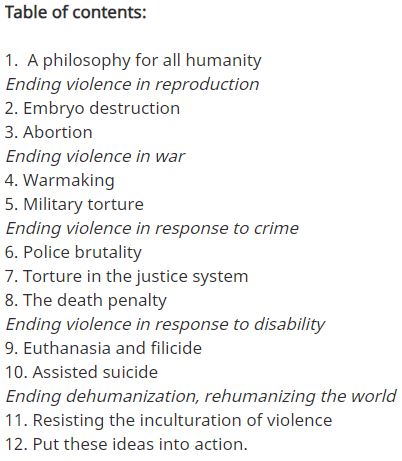
Following the introduction Murphy tackles many of the contentious issues relating to life such as embryo destruction, abortion, war, the death penalty, and euthanasia. Each chapter is thoughtfully organized with a brief, detailed, and easy-to-understand introduction on what the issue is followed by an ethical analysis and a history of the policy on the issue. Murphy pivots in the second half of the chapters by suggesting non-violent policy solutions to the issue while addressing several of the common arguments that are made in support of the issue she is discussing.
While Murphy is Catholic, Rehumanize does not look at the CLE through a faith lens. You do not have to be a person of faith to appreciate this book.
Every chapter invites the reader to evaluate their own beliefs and assumptions as each chapter ends with discussion questions in addition to further reading on the topic.
Simply put, Rehumanize is the best book for a comprehensive, yet accessible introduction to the CLE.
KEY QUOTE: “(The consistent life ethic is the) belief that all human beings, by virtue of their inherent human dignity, deserve to live free from violence.”
BONUS: Listen to Murphy discuss her book on Ethics and Culture Cast.
DID YOU KNOW? Sunday to Saturday has a Good Reads page where we post all of the books we have read – even the ones that didn’t make the cut.
More curated media on the consistent life ethic:

BOOK: Consistently Opposing Killing
What links abortion and euthanasia? War and poverty? The death penalty and embryonic research? Racism and environmental damage? Violence. Specifically violence against human beings. Through a collection of excerpts from books, journals, articles, and speeches Consistently Opposing Killing focuses on the key tenets of the consistent life ethic (CLE), details some of the history of…
Read more
BOOK: Consistently Pro-Life
If you asked a random person who identified as a Christian what a Christian ethic of life is or what the basic tenants of a consistent ethic of life are they would likely focus on abortion for the first question and not be able to answer the second question. Author Rob Arner, in Consistently Pro-Life:…
Read more
BOOK: Resisting Throwaway Culture
What would the world look like if Christians, and non-Christians, lived a life focused on a culture of hospitality and encounter? What if we rejected the pervasive consumerist culture that sees humans, especially the poor and the vulnerable, as commodities to be used? Professor of Medical Humanities at the Creighton University School of Medicine Charles…
Read more Sunday to Saturday