
By Nicholas Rogers | Amazon.com | 198 pages
Published in September of 2003
SUMMARY: Most Christians participate or do not participate in Halloween based on their own cultural context. Some reject the holiday outright saying it is a holiday devoted to Satan while others wholly participate. Both do so without knowing the history of the holiday. In Halloween: From Pagan Ritual to Party Night Nicholas Rogers touches on various aspects of Halloween such as its historical roots, cultural influences, folklore, and societal impact.
“To examine the history of Halloween is to recognize that it is not a holiday that has been celebrated the same way over centuries, nor one whose meaning is fixed,” Rogers pens.
Rogers’ work overlaps significantly with Lisa Morton‘s Trick or Treat?, but where Morton leans towards an analytical look at the history of the holiday Rogers distinguishes himself with an additional perspective from Canada in addition to his apt social commentary. Rogers’ engaging and approachable writing style makes his work more approachable for the average reader.
We have already detailed the tangled history of Halloween in our review of Morton’s book, so we won’t rehash the particulars. Through our reading, we have found it is helpful to think of Halloween in three distinctive phases.
The first phase is tied to the ancient Celtic New Year festival known as Samhain (SOW-en). It was a time of feasting, paying debts, and marked the transition from summer to winter. The most enduring trait of Samhain lies with the feeling of Halloween rather than any particular practice. Rogers notes that “(Samhain) represented a time out of time, a brief interval ‘when the normal order of the universe is suspended,’ and the time is ‘charged with a peculiar preternatural energy.'” Today, we would call that a spooky or otherwordly feeling.
“If Samhain imparted to Halloween a supernatural charge and an intrinsic liminality, it did not offer much in the way of actual ritual practices, save in its fire rites,” Rogers writes. “Most of these developed in conjunction with the medieval holy days of All Souls’ and All Saints’ Day.”
The second phase has to do with the Catholic church and its celebration of Hallowmas or Allhallowtide, a three-day celebration consisting of Halloween (Oct. 31), All Saints’ Day (Nov. 1), and All Souls’ Day (Nov. 2) to remember the dead. Many of the traditions of Halloween from the 8th and 9th centuries, such as divination with nuts and courting rituals, did not make it to our modern celebration. Today’s primary influence from the second phase comes from the name, Halloween, in addition to communicating with the dead and dressing up which comes from both pagan and Catholic customs.
The third, and current, phase is the secular iteration that revolves around trick-or-treating for kids and the celebration of the macabre for adults. The staples of the third phase distinctly shift to an American commercialization of Halloween, the grotesque, and the sexy with most Halloween revelers oblivious to the first two phases which leads us to one of Rogers’ salient points.
“How one celebrates Halloween, then, is very much an individual choice, and one that has given rise to considerable controversy about the limits of permissiveness, the boundaries of transgression, the propagation of sexual difference, the role Halloween plays in propagating the ‘American way of life,’ and the adult appropriation of what many still conceive as a children’s festival of fantasy,” Rogers writes.
This conclusion plays into why we think Christians can participate or not participate in Halloween. It is a holiday that has morphed and continues to morph through the years. We can choose to celebrate the good and reject the bad. Halloween: From Pagan Rituals to Party serves as an excellent starting point to learning about the holiday while offering a compelling and comprehensive exploration of Halloween through the ages.
KEY QUOTE: “To examine the history of Halloween is to recognize that it is not a holiday that has been celebrated the same way over centuries, nor one whose meaning is fixed. If it is a fixture in our annual calendar, it is also a holiday that has been reinvented in different guises over the centuries. Those reinventions can be related to the changing demographic regimes of the past; to the making of different ethnic, national, and sexual identities, to the shifting social and political anxieties of late twentieth-century America; and to the commercialization of leisure with which Halloween is now very much associated. It has always operated on the margins of mainstream commemorative practices, retaining some of the topsy-turvy features of early modern festivals–parody, transgression, catharsis, the bodily excesses of carnivalesque–and recharging them in new social and political contexts. That is part of the secret of its resilience and vibrancy.”
DID YOU KNOW? Sunday to Saturday has a Good Reads page where we post all of the books we have read – even the ones that didn’t make the cut.
More curated resources on Halloween:

FIVE QUESTIONS: Halloween
In a nutshell, what are Halloween’s roots and origins? What is one reason to celebrate Halloween? What is one reason not to celebrate Halloween? Should Christians celebrate Halloween? What are some ways to redeem Halloween?
Read more
LEARNING CAPSULE: Halloween
Most Christians reject or accept Halloween without much thought. Those who don’t like the holiday assume satanic origins while those who like the holiday celebrate with no critical thought. Before deciding whether to celebrate or not, please take the time to learn about the complex history of the holiday and the many ways Christians can…
Read more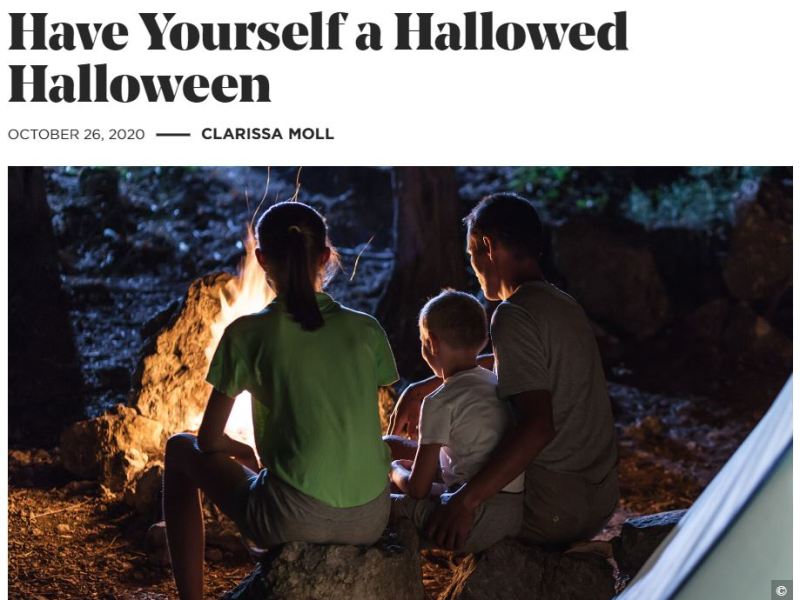
ARTICLE: Have Yourself a Hallowed Halloween
Instead of outright rejecting Halloween, author Clarissa Moll suggests four unique ways to “creatively opt-in” to celebrate the holiday with your kids.
Read more Sunday to Saturday