
By Lisa Morton | Amazon.com | 232 pages
Published in September of 2019
SUMMARY: Halloween has a complicated relationship with Christianity. The origins of the holiday, like many holidays, has its roots in ancient divination practices and lore while also having a distinctly Christian side. The near-constant metamorphosis of the holiday throughout the centuries in addition to the fact that the holiday deals with death has resulted in a muddled picture of what Halloween celebrates. In Trick or Treat? Lisa Morton traces the practices from the British Isles to the evolution of the holiday in America brought over by immigrants from Ireland to the modern-day commercialization of the event.
“Halloween is surely unique among festivals and holidays,” Morton writes. “While other popular calendar celebrations, including Christmas and Easter, have mixed pagan and Christian traditions, only Halloween has essentially split itself down the middle, offering up a secular or pagan festival on the night of 31 October and somber religious observance on the day of 1 November.
“Many of those who celebrate Halloween are unaware of its Catholic history or meaning…What began as a pagan New Year’s celebration and a Christian commemoration of the dead has over time served as a harvest festival, a romantic night of mystery for young adults, an autumnal party for adults, a costumed begging ritual for children, a season for exploring fears in a controlled environment and, most recently, a heavily commercialized product exported by the United States to the rest of the world.”
The birthplace of the holiday begins with the Celts who once lived in most of Europe and throughout the British Isles. They were a polytheistic people with superstitions (the number three is an important number in their religion), mythology (Samhain), and lore (the belief in fairies or sidh) that believed in the afterlife. During Samhain, a New Year’s festival, the Celts believed “that the doors between this world and that Otherworld (Tir na tSamhraidah, the afterlife) opened one night a year.”
The three-day Samhain celebration consisted of “feasting and sporting alternated with debt repayment and trials.” Celtic mythology contains disturbing stories (The Fomorians), romantic stories (The Dream of Angus Og), and ominous stories (The Adventure of Nera). It was a time to mark the end of summer and the beginning of winter. The mixture of supernatural beliefs, raucous partying, and harvest celebration are the bedrock of Halloween.
The history of the holiday gets muddled sometime in the seventh century after the Catholic faith had spread to most of Europe. The Catholic church “found that conversion was far more successful when attempts were made to offer clear alternatives to existing calendar celebrations, rather than simply stamping them out.” As a result, Catholic missionaries employed the doctrine of syncretism where “existing temples and even sacrificial rituals (were) not destroyed but rather turned to use for Christian purposes.”
Over time the Catholic church established Hallowtide or AllHallowtide which consists of All Saints (Hallows’) Eve or Halloween (Oct. 31), All Saint’s Day or Feast of the Saints (Nov. 1), and All Soul’s Day (Nov. 2). This was an attempt by the Catholics to co-opt or replace the pagan rituals, yet the Celts and other people groups did not fully embrace the change which results in the some of the confusion about the holiday today. Over thousands of years later it is difficult to parse out if the rituals of Samhain influenced Halloween or the other way around.
In addition to syncretism, the origins of Halloween are hard to pin down as the Celts did not believe in writing, and therefore the only evidence we have of their customs is from outside observers who may have had ulterior motives for painting them as barbarians or embellishing some of their rituals. For example, the Celts may have participated in human sacrifice, but there is no conclusive evidence.
Halloween made its way to America in the 1800s during the Potato Famine (1845-49) when half a million Irish immigrated to the United States, bringing with them their customs, lore, and mythology. The ships that brought the immigrants to the New World were called coffin ships due to the high rate of death and disease. The fact that the newly arrived immigrants were so familiar with death may help explain why Halloween traditions persisted in America.
Bonfires, dancing, bobbing for apples, pranks, and general mischief marked the holiday in America. Divination practices and fortune-telling games such as burning nuts (chestnuts, walnuts, hazelnuts) to see who would live another year or who a person would marry, pouring molten lead into water and interpreting the shapes, cutting an apple and eating it in front of a mirror at midnight, and carving faces into gourds are a few examples of popular traditions brought over by the Irish.
Over the years, the celebration oscillated between a celebration for adults to children and adults and back and forth. The pranking part of the holiday was eventually replaced with trick or treating, which originated in Canada in 1927 but didn’t take root until after World War II when Americans had access to luxury items again. Pumpkin carving replaced gourd carving. For the most part, Halloween was a whimsical, magical holiday, but that started to change in the 1900s as the celebration moved from a harvest festival and remembrance of loved ones to a festival of night and death.
Halloween went mainstream and started to go commercial in the ’60s when Disney opened its wildly popular Haunted Mansion ride and It’s the Great Pumpkin, Charlie Brown was televised in 1968. The social upheaval of the 60s and 70s also facilitated a transition of the holiday from the quirky to the macabre. The slasher movie Halloween was released in 1978, signaling the start of graphic violence and sexually explicit content being associated with the holiday. Disney’s The Nightmare Before Christmas release in 1993 continued the commodification of the holiday while Michael Jackson’s “Thriller” video catapulted Halloween to immense popularity.
Americans spend over 10 billion each year on Halloween – second only to Christmas. There are Halloween advent calendars, Halloween Christmas trees and ornaments, Halloween inflatable decorations featuring Star Wars characters holding pumpkins, and state-of-the-art animatronics sure to scare the bravest. What was once celebrated, at least in part, as a harvest festival, has been almost completely transformed, in many instances, into a celebration of the grotesque. So, where does that leave a Christian in how to approach the holiday?
First, we have to recognize the pagan and Christian origins of the holiday. The history of the holiday, at its very best, is muddled. Second, we have to accept the fact that the holiday has morphed over time and will continue to do so. Many Americans’ associations with Halloween are recent, coming within the last 60 years. Third, what Halloween means to one person may be entirely different for another person.
“Halloween is — as folklorist and Halloween expert Jack Santino has noted — ‘polysemic’: it holds different meanings in different places and times, and even to different persons within a single place,” Mortin writes. “To the modern adult American, it’s a chance to indulge fears in an environment that is relatively safe, because it’s defined by art and imagination. To a contemporary Russian, it’s a night on which to exercise freedom of expression. For a Scandinavian, it might be the last celebration before the long, dark winter sets in.
“But 500 years ago — in what we think of as Halloween’s infancy — it was perceived very differently. In a world just emerging from the Dark Ages and still under the threat of the plague, All Hallows’ was a curious and uncertain mix of pagan and Christian, magic and medication, raucous festival and somber reflection.”
In summary, Halloween is both sacred and scary, but how you choose to celebrate it is up to you. For a Christian, it is the intentions of one’s actions on Halloween that matter. Are you worshipping something other than God, or do you dress up, have fun, and use the opportunity to meet your neighbors?
One thing to note is that Trick or Treat? is an academic look at Halloween’s history and therefore can be dry at times. If you do not have an innate interest in the holiday, this book may not be for you. For a more accessible book, we recommend Halloween: From Pagan Ritual to Party Night by Nicholas Rogers.
KEY QUOTE: “The unassailable facts of Halloween are fourfold. First, it boasts both a pagan and Christian history. Second, its position in the calendar–at the end of the autumn/beginning of winter– means it has always served in part as a harvest celebration. Third, it is related to other festivals of the dead around the world and so has always had a somber, even morbid element. Finally, however, its combination of pagan New Year celebration and joyful harvest feast have also given it a raucous side, and it has almost always been observed with parties and mischief-making.”
BONUS: Listen to Morton discuss the history of Halloween on PreserveCast.
DID YOU KNOW? Sunday to Saturday has a Good Reads page where we post all of the books we have read – even the ones that didn’t make the cut.
More curated resources on Halloween:

FIVE QUESTIONS: Halloween
In a nutshell, what are Halloween’s roots and origins? What is one reason to celebrate Halloween? What is one reason not to celebrate Halloween? Should Christians celebrate Halloween? What are some ways to redeem Halloween?
Read more
LEARNING CAPSULE: Halloween
Most Christians reject or accept Halloween without much thought. Those who don’t like the holiday assume satanic origins while those who like the holiday celebrate with no critical thought. Before deciding whether to celebrate or not, please take the time to learn about the complex history of the holiday and the many ways Christians can…
Read more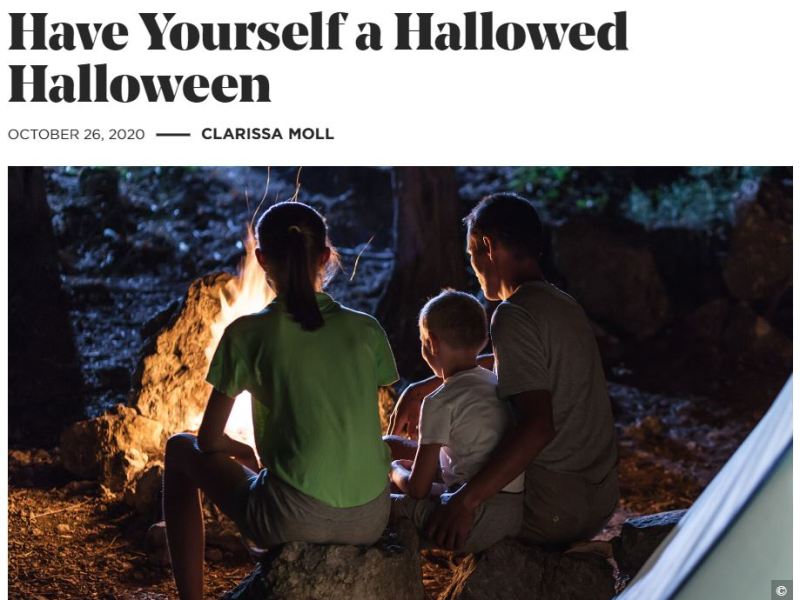
ARTICLE: Have Yourself a Hallowed Halloween
Instead of outright rejecting Halloween, author Clarissa Moll suggests four unique ways to “creatively opt-in” to celebrate the holiday with your kids.
Read more Sunday to Saturday