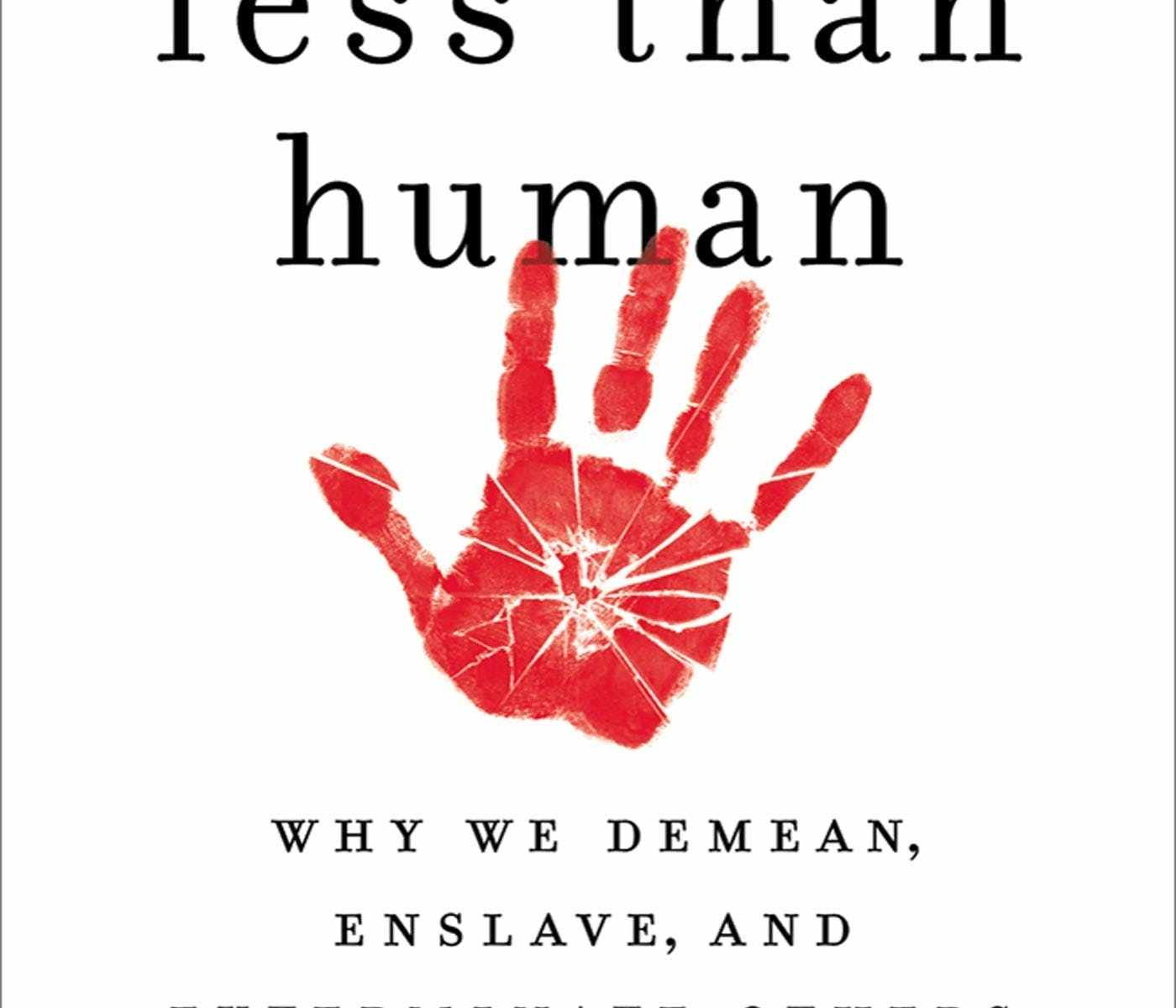
By David Livingstone Smith | Amazon.com | 336 pages
Published in February of 2012
SUMMARY: The majority of humans would agree that murder is wrong, and yet human history is littered with genocide, whole populations being kidnapped and enslaved, and wars replete with ghastly atrocities. How is it that we can say the murder of another human is terrible, but in an instant dehumanize a fellow human and perform, or at least allow, dehumanizing acts? In Less Than Human, professor of Philosophy at the University of New England David Livingstone Smith pulls from history, biology, philosophy, and anthropology to perform an in-depth analysis of dehumanization and why we seem predisposed to dehumanizing others.
Dehumanization “is the belief that some beings only appear human, but beneath the surface, where it really counts, they aren’t human at all… It isn’t a way of talking. It’s a way of thinking–a way of thinking that, sadly, comes all too easily to us.”
Livingstone Smith chronicles the building blocks of dehumanization throughout history, beginning with Aristotle, before tracing the roots to David Hume and Immanuel Kant. He touches on the great chain of being (that everything is on a hierarchical scale with God and humans at the top and plants near the bottom) and our propensity for sorting humans into buckets.
This hierarchical view and the ability of humans to sort others into groups is the bedrock from which dehumanization is built. Without the ability to sort people into groups and label them better or worse, there would be no dehumanization. These human predispositions are exploited by those in power by stoking fear of the “other,” labeling them as “counterfeit human beings.” Livingstone Smith says dehumanization is not exclusively an internal issue but also a product of our environment. Therefore, the words we use matter.
Vermin, parasites, maggots, rats, worms, dogs, wolves, dirty, unclean, filthy, disease carriers, rapists, murderers, degenerates, thugs. All these words have been used, and continue to be used, to dehumanize others. Immigrants at the southern border are not people, they are “rapists” or “carriers of disease.” Black people marching in the streets are not protesters; they are “thugs” or “degenerates.”
When we use the above phrases, it allows us to see the “other” as non-human, more as an animal or virus that needs to be neutralized or exterminated.
Perfectly illustrating this concurrence of events is lynching in America. Many church-going people would go to church, have knowledge about the 10 commandments, agreeing with the sixth commandment to not kill, but attend a lynching after church complete with pictures and snacks in a festive atmosphere. Many white Southerners simply did not see Black people as human, but as vermin to be exterminated. (For a comprehensive history of lynching, we recommend At the Hands of Persons Unknown by Philip Dray)
“When a group of people is dehumanized, they become mere creatures to be managed, exploited, or disposed of, as the occasion demands,” Livingstone Smith writes.
Livingstone Smith says this theme of dehumanizing others by labeling them as animals or bugs shows that people do not believe the “other” has a human “essence.” This essence is innate in humans – it is an undefinable trait that makes a human a human. A belief that we are different, more valuable than animals and plants. For millennia, humans have been trying to answer the question: what makes a human a human?
Is it tied to a higher order of thought? Our industriousness? Our culture? Our developed emotions? Is it our skin color or another physical characteristic? But, anytime someone tries to answer what makes a human a human, a group of people is always left out. They are seen as the “other” and have the potential to be dehumanized.
This leads to the largest critique of the book. While Livingstone Smith does a superb job of tracing the roots of, defining, and showing why humans are prone to dehumanization, he does not provide a path forward (although he did write a follow-up, which we have yet to read, titled, On Inhumanity, with ideas on how to resist dehumanization).
This is where the Christian faith, despite being bastardized to justify atrocities throughout the centuries, can provide a path forward. The foundational doctrine of the image of God says that all humans are made in the image of God – full stop. There is no specific characteristic or list. It is not up to us to determine who is worthy or who is not – it is an impossible task for us.
As Lucy Peppiatt says in The Imago Dei: Humanity Made in the Image of God, it is a great leveling doctrine. The mysteriousness of this doctrine has one purpose and points to one thing: being made in the image of God.
Overall, Less Than Human is a well-researched and thought-provoking book that provides important insights into the dangers of dehumanization. It is worth considering if you are interested in understanding how dehumanization operates in society, but we recommend reading Peppiatt’s The Imago Dei: Humanity Made in the Image of God to round out your reading on this subject.
KEY QUOTE: “We are all potential dehumanizers, just as we are all potential objects of dehumanization. The problem of dehumanization is everyone’s problem.”
BONUS: Listen to Livingstone Smith talk about dehumanization on the Curious Minds at Work podcast.
DID YOU KNOW? Sunday to Saturday has a Good Reads page where we post all of the books we have read – even the ones that didn’t make the cut.
Our latest curated media:

BOOK: The Faithful Spy
John Hendrix’s The Faithful Spy is an engrossing and visually arresting account of Dietrich Bonhoeffer—a German pastor whose fierce moral clarity led him into the heart of a conspiracy to resist, and ultimately assassinate, Adolf Hitler.
Read more
BOOK: The Ragamuffin Gospel
The Ragamuffin Gospel is not so much a theological treatise as it is a wake-up call—one delivered gently but insistently to the soul that keeps trying to earn what Christ has already given. Manning’s premise is simple: most Christians do not actually believe in the incomprehensible, unearnable grace of God. We nod politely at grace…
Read more
LEARNING CAPSULE: Thanksgiving
America’s origin story is deeply tied to Thanksgiving and the Pilgrims. Unfortunately much of what we have been taught in school is not true. Below are our favorite resources to relearn Thanksgiving.
Read more Sunday to Saturday