
By Bonnie Kristian | Amazon.com | 233 pages
Published in October of 2022
SUMMARY: The late pastor James Atwood believed guns to be the biggest problem facing the American church. Author Jemar Tisby argues that racism and white supremacy are. In Untrustworthy, Bonnie Kristian asserts the largest problem facing American churches is epistemic (epistemic — of or relating to knowledge or knowing). According to Kristian — the poisons of cancel culture, conspiracy theories, and skepticism of experts in conjunction with social media algorithms incentivized to make money at all costs are the largest problems facing the American church. Kristian posits that if we can’t agree on whom to trust or what is true then everything else is a moot point.
“We don’t know what is true, what is knowable, what is trustworthy. Our information environment is chaotic and overwhelming, rife with conspiracy theories, ‘fake news,’ and habit-forming digital manipulation,” Kristian writes. “It is breaking our brains, polluting our politics, and corrupting Christian community. It may be the most pressing and unprecedented challenge of discipleship in the American church.”
Untrustworthy explores the various factors contributing to the widespread problem of distrust in contemporary society. Kristian, a journalist and political commentator, offers a compelling analysis of the erosion of trust in various institutions, including government, media, and corporations. She delves into the root causes of the problem, such as the impact of social media algorithms, the rise of fake news, and the impact of partisan politics on public trust.
Kristian says we only need to look at the current state of public discourse in America for the effects of this epistemic crisis that manifests itself “in the gullibility and quarrelsomeness that has us spreading fabrications and fallacies on social media, the proliferation of so-called satire intended to fool, rather than enlighten and bemuse, and the popularity of political and religious memes that consist of apocryphal quotations, cheap manipulations, and bad math.”
Kristian identifies and critiques six realms: media, both traditional and social, mob (cancel culture), schemes (conspiracy theories), skepticism (distrust of experts), emotion, and experience (identity), where the epistemic crisis is festering. In each chapter, she skillfully and clearly explains the reasons why each subject is contributing to the epistemic crisis and why we should care.
For instance, in chapter three she says that cancel culture exacerbates the epistemic crisis because “there is no due process” and “there is permanent rejection with no path to change one’s mind.” The boundary is constantly changing and once that boundary is crossed there is no path to reconciliation. In chapter four, she identifies why conspiracy theories are appealing to many people (they provide community, people like to help, like to be right, and like patterns) and why conspiracy theories are happening in churches (bad theology, political allegiance, and authority).
“Conspiracism is always epistemic poison. This accusatory, credulous mindset, more than any individual theory, is what contributes to our epistemic crisis,” Kristian writes. “It treats confirmation bias as confirmation, rumor as research, and innuendo as proof. It isolates its victims and builds their community on a foundation of sand. It falsely labels ideas and behaviors unconnected to reality as a heroic search for truth. And all those downsides, ironically, are part of conspiracism’s appeal. They’re part of why people believe.”
Laced throughout each chapter is a call to truth and accuracy. Christians are called to seek the truth and to reject falsehoods and deception. This means being discerning in our consumption of media and being willing to challenge narratives that are not grounded in truth.
Part of living out this truth is being ruthlessly judicious in the media we share and the words we use on social media. Kristian argues that trust begins with personal responsibility and integrity. As Christians, we are called to live lives of integrity, being truthful in our words and actions. By living out our faith in this way, we can model the kind of honesty and integrity that builds trust in our communities and in the broader society.
In the final three chapters, Kristian provides a treasure trove of easy-to-follow advice on ways to combat this epidemic. She devotes roughly a third of the book to ways to actively work against the crisis. Kristian believes that it is not enough to identify and eliminate the bad habits, but we need to replace the practices with better, life-giving ones.
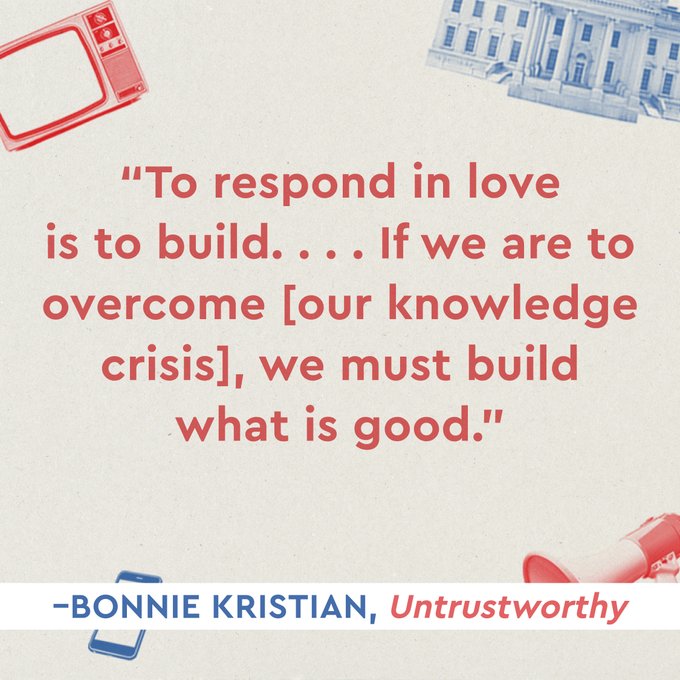
Chapter eight is devoted to six epistemic virtues (humility, studiousness, intellectual honesty, wisdom, love and obedience) where she details what each trait is and is not. Chapter nine touches on habits such as arranging spaces for virtue (non-TV centric), avoiding passive consumption of media, and carving out time for weekly, daily, monthly and yearly sabbaths from media.
We particularly liked the tips for engaging with social media in a healthy way – especially the advice to logon for a specific purpose and time and to avoid random scrolling.
In the final chapter Kristian extols Christians to be a breath of fresh air. This means being in relationships with people, having humility, listening, and being patient.
Untrustworthy provides a deeper understanding of the causes and consequences of distrust and offers practical suggestions for rebuilding trust in our communities and in society as a whole. Its clear and well-organized writing style, thoughtful analysis, and well-researched arguments make it a must-read for anyone seeking to better understand this important topic.
KEY QUOTE: “How we handle knowledge and how we assess truth claims are crucial for the development and outworking of our faith as Christians. It’s fundamental to everything in the political arena and so much of our private lives as well. The simplest conversations can feel impossible when we can’t agree about what is true–or whether and how truth can even be found. And if we can’t talk to one another, how do we worship together? How do we govern together? How do we live together?”
BONUS: Don’t have time to read the book? Watch Kristian talk about Unstrustworthy on PressOn.
DID YOU KNOW? Sunday to Saturday has a Good Reads page where we post all of the books we have read – even the ones that didn’t make the cut.
Our latest curated content:

BOOK: The Faithful Spy
John Hendrix’s The Faithful Spy is an engrossing and visually arresting account of Dietrich Bonhoeffer—a German pastor whose fierce moral clarity led him into the heart of a conspiracy to resist, and ultimately assassinate, Adolf Hitler.
Read more
BOOK: The Ragamuffin Gospel
The Ragamuffin Gospel is not so much a theological treatise as it is a wake-up call—one delivered gently but insistently to the soul that keeps trying to earn what Christ has already given. Manning’s premise is simple: most Christians do not actually believe in the incomprehensible, unearnable grace of God. We nod politely at grace…
Read more
LEARNING CAPSULE: Thanksgiving
America’s origin story is deeply tied to Thanksgiving and the Pilgrims. Unfortunately much of what we have been taught in school is not true. Below are our favorite resources to relearn Thanksgiving.
Read more Sunday to Saturday